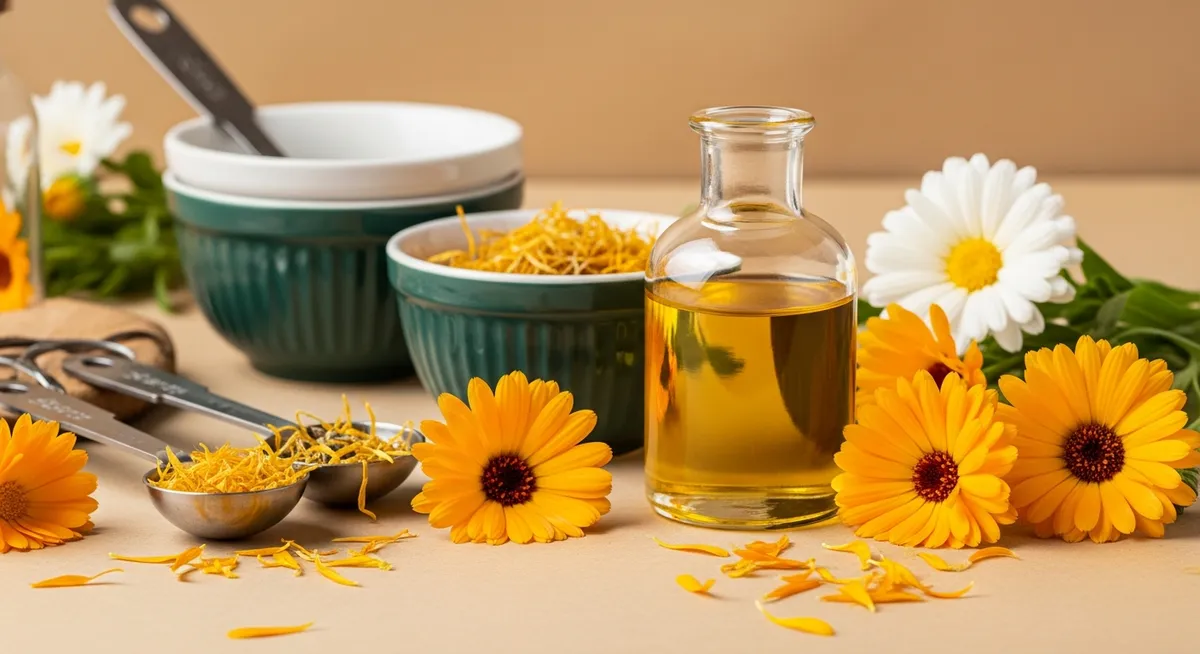
Making a Calendula Cuticle Oil at Home, Step by Step
A cuticle oil is just a moisturizer for the skin around the nail, and the simplest version needs one ingredient: a plain calendula oil. No published trial shows calendula, or any oil, makes nails stronger, so this recipe makes no strength claim. What it gives you is a clean, low-risk way to keep the nail fold from drying out, plus the dermatologist-sourced habits that matter more than the oil does.

Calendula Oil
Our own small-batch calendula oil, in sizes from 0.5 oz to bulk.
From $13.99
Shop Calendula Oil →Decide what you are actually dealing with
Dry nails and cuticles have different causes, and the cause decides whether an oil is the answer.
- Rough or scaly cuticles, nails splitting or peeling after dishes and cleaning. The American Academy of Dermatology says "too much water exposure can weaken your nails, causing them to split, peel, or break," and advises gloves for cleaning and washing dishes and moisturizing after hand washing (AAD, healthy nail tips). An oil fits here, after the gloves.
- Brittle nails that keep splitting. A 2020 review says brittleness affects up to 20% of people, with a primary form and forms secondary to inflammatory nail disorders, infections, systemic disease, trauma and altered nail hydration, and that optimal management means addressing the cause when one exists (Chessa et al., Dermatol Ther (Heidelb), 2020). It says topical moisturizers "could be considered" for the plate. That is a modest statement, and we repeat it at that strength.
- Nails that change, swell or hurt. The AAD says to see a dermatologist, and notes that for people with diabetes or poor circulation it is especially important to seek care for any nail problem. No oil belongs in this category.
Do not skip the one thing most recipes ignore: leave the cuticle alone
The AAD's list says not to bite fingernails or remove the cuticle, because doing so "can damage the nail." No oil offsets cutting. If you want healthy cuticles, moisturizing them and not trimming them is the sourced approach.
Version one: use the oil as it is
This is what we would do, and it needs no recipe. Our oil is calendula extract in a carrier oil with nothing else added, so it is already a finished cuticle oil.
- Wash and dry your hands. FDA's guidance on cosmetic microbial safety includes washing hands before dipping fingers into a container (FDA, Microbiological Safety and Cosmetics). A small dropper bottle avoids dipping altogether.
- Put one small drop on the skin at the base of each nail and rub it in around the nail fold. Use less than you think; the AAD gives no amount, and we know of no source that does.
- Do it after you wash your hands, which is when the AAD says to moisturize. The sources give no frequency beyond that, so adjust by how your skin feels.
- Wear gloves for water work first, and apply the oil afterward, not under the gloves.
We do not recommend a vitamin E additive. Commercial calendula macerates sometimes include one: a supplier data sheet for a sunflower-based organic macerate lists 0.2% added tocopherol (Golgemma/Biolandes, FB026, 2025). Ours has no added tocopherol, preservatives or stabilizers, and no source we found shows that adding any improves a cuticle oil for the user.
Version two: a cuticle balm that stays where you put it
A balm is easier to carry and does not run, and it is the only version where a quantity is useful. A widely used starting ratio is about 1 part beeswax to 4 parts infused oil, using less wax for softer and more for firmer (Mountain Rose Herbs). That recipe mixes ounces by weight for wax and by volume for oil, so treat 1:4 as a starting point and test the set on a spoon.
- Weigh or measure 1 part beeswax to 4 parts calendula oil in the recipe's own units.
- Melt the wax with the oil in a double boiler over low heat, just until clear.
- Pour into a clean, dry tin or small jar and let it set undisturbed.
- Label it with the date.
Keep water out: the only microbial limit is liquid water, as a 1995 review put it, and water-containing cosmetics are the ones that need preservatives (Brannan, J Soc Cosmet Chem, 1995). Do not add water, hand cream or aloe gel to this balm. A balm is a tin you dip into, so use a clean fingertip or a small spatula. Our salve recipe covers the same method in a larger batch, and our lotion bar article covers a firmer format.
If you make products to sell, FDA states that making cosmetics at home is not illegal, but the maker must ensure safety and label correctly (FDA, small businesses and homemade cosmetics).
Skip the essential oils and the extras
Older recipes for this topic add essential oils. We would not. The nail fold is where skin breaks easily, and the National Association for Holistic Aromatherapy notes that damaged or inflamed skin "is often more permeable to essential oils" and that sensitization is also more likely there (NAHA). Reasoning from that, a plain oil has fewer ways to cause a reaction, and if you do react, a one-ingredient product tells you what caused it.
Storage and shelf life: where sources disagree
Keep the bottle closed, cool and out of light. The commercial data sheet above gives 36 months for a sealed macerate stored at 15-25 C protected from air and light, which is a supplier's quality specification for its own product, not a promise for a tin you opened and dipped into. University of Maine's extension advises using homemade infused oils within three months and Mountain Rose says its salves keep 1 to 3 years (UMaine Extension, Bulletin 4385). Those numbers disagree because they describe different products, so we give no single number. Our bottles are dated and lot-numbered, and you can read about storage separately.
Who should not use it, and what we cannot say
Calendula is in the daisy family, and the EU herbal monograph lists hypersensitivity to Asteraceae plants as a contraindication (EMA/HMPC, 2018). If the skin around your nails is cracked, patch test on the forearm first; our patch test walkthrough explains how. We found no trial of calendula for nails or cuticles, and a 2018 systematic review of interventions to prevent hand dermatitis in wet-work occupations found no studies that met its inclusion criteria for moisturizers or barrier creams (JBI Database System Rev Implement Rep, 2018). So we cannot promise the oil helps, and gloves remain the sourced advice. Our sibling article on nail and cuticle care and the winter article on hands in cold weather add context.
If you want to start with the plain version, our calendula oil is a ready-made cuticle oil with nothing added, and batch documentation is available on request; if a nail looks wrong, a dermatologist is the better first stop.
Calendula Oil
Nature's Golden Botanical, bottled: small-batch calendula oil in sizes from 0.5 oz to bulk.
From $13.99
Shop Calendula Oil →Sources & Further Reading
- American Academy of Dermatology, accessed 2026-10-14. 11 dermatologists' tips for healthy nails. aad.org
- Chessa MA, Iorizzo M, Richert B, Lopez-Estebaranz JL et al., 2020. Pathogenesis, Clinical Signs and Treatment Recommendations in Brittle Nails: A Review. Dermatol Ther (Heidelb) 10(1):15-27. pubmed.ncbi.nlm.nih.gov
- FDA, accessed 2026-10-14. Microbiological Safety and Cosmetics. fda.gov
- Golgemma/Biolandes, 2025. Technical data sheet, Calendula Org Macerate/Oil, FB026. biolandes.com
- Mountain Rose Herbs, accessed 2026-10-14. How to Make Herbal Salves (blog). blog.mountainroseherbs.com
- Brannan DK, 1995. Cosmetic preservation. J Soc Cosmet Chem 46:199-220. library.scconline.org
- FDA, content current 11/18/2025. Small Businesses and Homemade Cosmetics: Fact Sheet. fda.gov
- National Association for Holistic Aromatherapy, accessed 2026-10-14. Safety. naha.org
- University of Maine Cooperative Extension. Bulletin 4385, Safe Homemade Flavored and Infused Oils. extension.umaine.edu
- EMA/HMPC, 2018. European Union herbal monograph on Calendula officinalis L., flos (Revision 1), EMA/HMPC/437450/2017. ema.europa.eu
- JBI, 2018. Effectiveness of interventions for preventing occupational irritant hand dermatitis: a quantitative systematic review. JBI Database System Rev Implement Rep. pubmed.ncbi.nlm.nih.gov