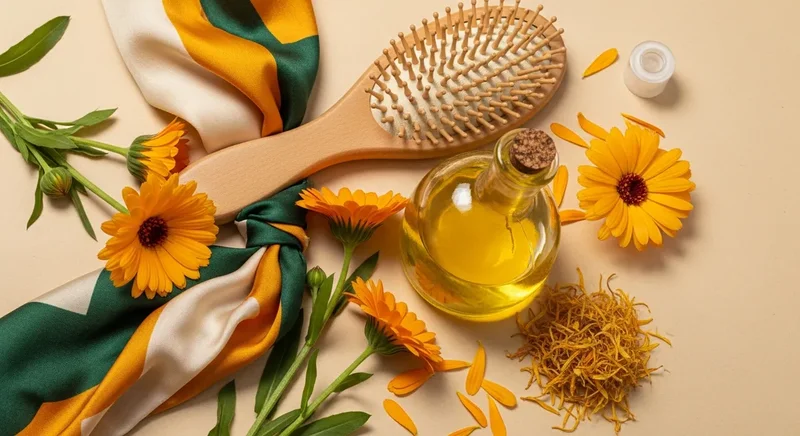
Calendula Oil for Hair: Product Buyer's Guide & Recommendations
If you are shopping for a calendula oil to use on your hair, the most important fact is that nobody has tested calendula on hair, so the buying decision comes down to things that can be checked: what carrier oil the calendula is in, how fresh it is, and what the label and paperwork actually disclose. We make one product, an infused calendula oil, and this is how we would walk you through choosing one, ours or anyone's.

Calendula Oil
Our own small-batch calendula oil, in sizes from 0.5 oz to bulk.
From $13.99
Shop Calendula Oil →First, what you are not buying evidence for
A PubMed search run on 14 October 2026 combining calendula with hair, alopecia, scalp and dandruff terms returned no relevant human study. The calendula research that exists is on other skin: ointments and creams for radiotherapy skin reactions, wound trials, diaper dermatitis. A 2019 systematic review of 14 studies (Givol et al., Wound Repair Regen) found faster early wound repair in animal studies and one human trial, and asked for larger randomised trials; none of it concerned hair. So any product page that promises thicker, stronger or faster-growing hair from calendula is claiming something no source we have found supports. If hair loss is your actual concern, that is a question for a dermatologist, and our article on the baldness claim goes through why.
What you can reasonably expect from a calendula oil on hair is what any oil does: coat the strand and the scalp surface. That makes the carrier, not the flower, the main variable in how it behaves on your hair.
The carrier question, with the one study that exists
A 2003 study (Rele and Mohile, J Cosmet Sci) compared coconut, sunflower and mineral oil on hair. It reported that coconut oil reduced protein loss in both undamaged and damaged hair when used before or after washing, while sunflower and mineral oil did not. The authors work at a company that makes hair oils, and the study was on oils themselves, not calendula infusions, so treat it as a single industry-authored data point rather than settled fact. Its usefulness here is the principle: oils differ in how they behave on hair, and the difference comes from their fatty acids.
Those fatty acids vary more than product pages admit. USDA reference data show that "sunflower oil" can mean a high-linoleic oil (about 65.7 g of linoleic acid per 100 g) or a high-oleic oil (about 82.6 g oleic and under 4 g linoleic), and a label that says only "sunflower" does not tell you which. Olive oil is mostly oleic, in a 2024 review's range of roughly 55-83%. Coconut oil is mostly saturated, with lauric acid at about 42 g per 100 g in USDA data. Jojoba is a liquid wax of long-chain wax esters, not a triglyceride oil at all. These are separate things to ask about, and all of them are answered on a data sheet, not on a front label.
An infused oil's make-up is mainly that of its carrier. That is reasoning from separate petal and carrier data, not a measurement: at the 1:10 flower-to-oil ratio the EU herbal committee gives for oil extracts, 10 g of petals sit in 100 g of oil, and the lipid that solvent can pull from petals is a small fraction of that mix. One 2025 study found that macerating herbs in some cold-pressed oils shifted fatty acid proportions, so "close to the carrier" is the safe way to put it. Our oil is calendula extract brought into a carrier oil. Our public pages do not name the carrier, so if you need to know it for your hair type or an allergy, ask: the batch paperwork lists it, and you can email the lot number to [email protected].
Freshness is the second thing to check
An oil on your hair that has gone rancid smells it, and that smell lingers. The more double bonds a fatty acid has, the faster it oxidises: a 2025 review (Gharby et al.) tabulates relative oxidation rates for C18 acids as 1 for stearic, 10 for oleic and 100 for linoleic, and lists light, heat, oxygen and metal ions as accelerators. So a linoleic-rich carrier is more fragile than an oleic-rich one, whatever the calendula content. Buy accordingly: dark glass, a date on the bottle, and use it within a sensible time. Our bottles are dated and lot-numbered, in glass, and because we add no preservatives, tocopherol or stabilizers, we would rather you use a bottle promptly than hold it for a year.
On paperwork: ask any supplier for a Certificate of Analysis for the lot you are buying and look at which tests are on it. A 2023 review of botanical adulteration (Gafner et al., J Nat Prod) notes that a certificate shows only the tests that were run, and that UV-based colour or total-pigment readings cannot show which plant a colour came from. Every batch of ours goes to independent third-party labs for physical assays, chemical assays and contaminant screening, and the batch documentation is available on request; a Certificate of Analysis is also linked on the shop page. We do not quote lab numbers in articles because the document is the source, and you should be equally unimpressed by any seller who quotes a percentage with nothing behind it.
Reading the label
- Ingredient list. An infused calendula oil is often declared as the carrier oil plus "Calendula Officinalis Flower Extract." The name alone does not say how much calendula is in the bottle.
- "Cold-pressed calendula oil." Cold-pressing is a mechanical method applied to seeds, nuts and fruit; a 2026 review describes it that way. Calendula petals are infused or extracted, not pressed, so the phrase most likely describes the carrier. Our article on cold-pressed vs infused goes deeper.
- "Organic." FDA has no definition of the word for cosmetics; USDA's rules apply only to certified products. We say organically grown, and we do not claim certification.
- Additives. Some commercial calendula macerates add tocopherol; one supplier data sheet we read lists 0.2%. That is a legitimate choice. It is also something a label should disclose.
As a fair comparison, two US brands publish their formulas on their own product pages. Mountain Rose Herbs lists organic olive oil, organic calendula flowers, organic alcohol and vitamin E oil, and says it uses an alcohol-assisted solar infusion. Herb Pharm lists certified organic olive oil with calendula extractives, with a multi-country origin list. We have not tested either, and both disclose more on the page than many products do.
Scalp, colour and who should skip it
Calendula is in the Asteraceae family. The EU monograph (EMA/HMPC, 2018) lists hypersensitivity to Asteraceae plants as a contraindication and notes skin sensitization, frequency unknown, and in one Austrian patch-test series of 443 dermatitis patients (Reider et al., 2001), 9 (about 2%) reacted to marigold. Those were clinic patients, not the public. On the scalp, a reaction can be mistaken for dryness or dandruff, so patch test on the inner forearm before putting an oil near your hairline; see our patch test article. Skip it if you have a daisy-family allergy, a scalp condition under a dermatologist's care, or if the EMA's cautions for pregnancy, breastfeeding or children under 6 apply to you.
One practical point is reasoning, not testing: the oil's orange comes from carotenoids, which a 2003 HPLC study (Pintea et al.) measured at 48 to 276 mg per 100 g of fresh flowers across four varieties. A pigmented oil may tint very light, gray or bleached hair and pillowcases, so try a small amount on a hidden strand first.
How we would decide
- Decide what you want the oil to do on hair. If it is conditioning, choose by the carrier, and check it against the fatty acid points above.
- Start with the smallest size. Our 4 oz and 8 oz bottles are what our bulk guide suggests for compatibility testing, and 16 oz for a first small production run if you are making hair products for sale.
- Ask for the lot paperwork before you commit to a larger size.
- Stop if the scalp gets itchy or red, and see a dermatologist if it persists.
For making a mask, see our hair mask article, and for the carrier side of blending, the carrier oils article. Whatever you buy, ask the same three questions: what is the carrier, how fresh is it, and what does the paperwork show.
Calendula Oil
Nature's Golden Botanical, bottled: small-batch calendula oil in sizes from 0.5 oz to bulk.
From $13.99
Shop Calendula Oil →Sources & Further Reading
- Givol et al., 2019. A systematic review of Calendula officinalis extract for wound healing. Wound Repair Regen. PMID 31145533
- Rele AS, Mohile RB, 2003. Effect of mineral oil, sunflower oil, and coconut oil on prevention of hair damage. J Cosmet Sci. PMID 12715094
- USDA Agricultural Research Service. FoodData Central, SR Legacy (sunflower, olive and coconut oil entries). fdc.nal.usda.gov
- Abdalla et al., 2024. A comprehensive review of plant-based cosmetic oils. ACS Omega. PMC11541506
- Gharby et al., 2025. Vegetable oil oxidation: mechanisms, impacts on quality, and approaches to enhance shelf life. Food Chem X. PMC12146556
- Laskos et al., 2025. Herbal maceration modulates fatty acid profile of cold-pressed oils. Sci Rep. PMC12586497
- Gafner et al., 2023. Botanical ingredient forensics. J Nat Prod. PMC9972475
- Dash et al., 2026. Cold pressed oils: a systematic review. Front Nutr. PMC13371722
- FDA. Organic Cosmetics. fda.gov
- Golgemma (Biolandes). Technical data sheet, organic calendula macerate FB026. biolandes.com
- Mountain Rose Herbs. Calendula Herbal Oil Organic product page. mountainroseherbs.com
- Herb Pharm. Calendula Oil External Use product page. herb-pharm.com
- EMA/HMPC, 2018. European Union herbal monograph on Calendula officinalis L., flos. ema.europa.eu
- Reider et al., 2001. The seamy side of natural medicines. Contact Dermatitis. PMID 11722485
- Pintea et al., 2003. HPLC analysis of carotenoids in four varieties of Calendula officinalis L. flowers. Acta Biol Szegediensis. abs.bibl.u-szeged.hu