Calendula Oil on a Label: Infused, Pressed, or Something Else?
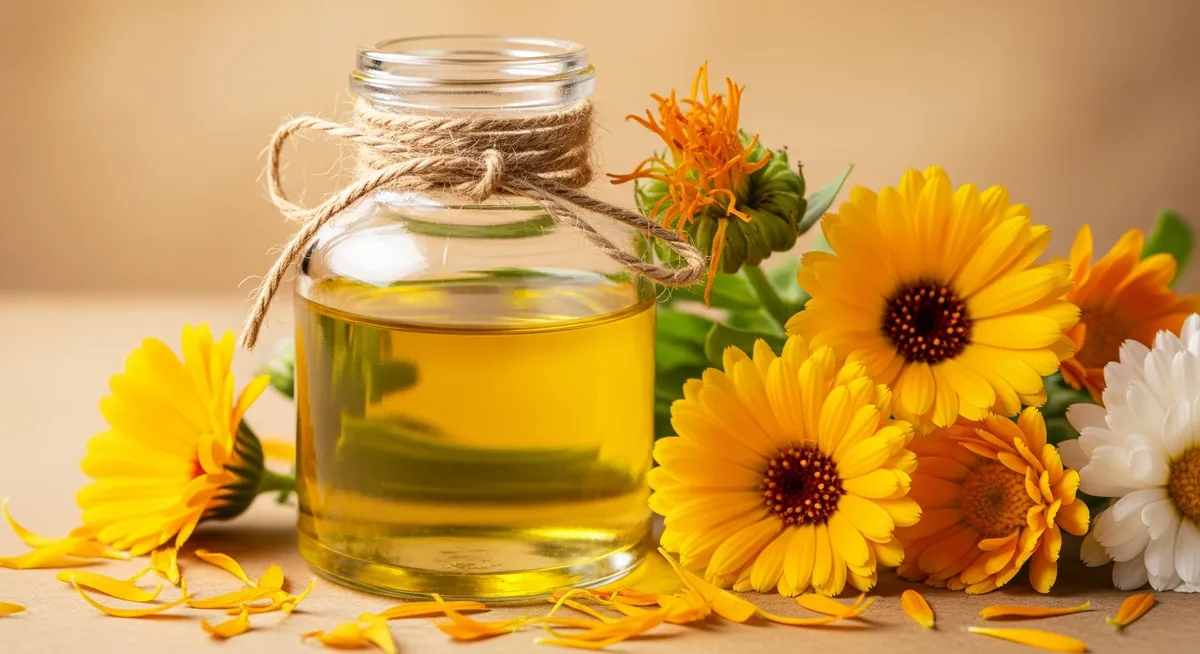
If a bottle says "cold-pressed calendula oil," one of two things is true: it is a different product than you think, or the label is using the words loosely. Calendula petals are soaked in oil, not pressed, so the calendula oil most people mean (orange, made from petals) is an infused oil. Ours is one. The rest of this page is how we would read a calendula oil label before buying, ours included.

Calendula Oil
Our own small-batch calendula oil, in sizes from 0.5 oz to bulk.
From $13.99
Shop Calendula Oil →First, what "cold-pressed" means
A 2026 systematic review describes cold pressing as a mechanical technique that avoids heat and solvents, applied to "seeds, kernels, fruits, and peels" (Dash et al., Frontiers in Nutrition, 2026). Olive, almond and jojoba are examples. Nothing in the sources we read describes pressing flower petals for oil; petal products are infusions or extracts. That is an inference from how those sources describe each process, but a consistent one.
The wrinkle is that calendula does have a pressable part: the seed. Calendula seed oil is real, and it is chemically unusual. In an 11-genotype study, calendic acid made up 51-58% of the seed-oil fatty acids (Dulf et al., Chemistry Central Journal, 2013). Solvent extracts of the petals, by contrast, were mostly oleic and linoleic acid (about 42% and 17% of fatty acids in one small Macedonian study; Rafajlovska et al., 2012). So a "cold-pressed calendula oil" could legitimately be a seed oil, which is a different material with a different fatty acid profile from an oil infused with petals. A label should say which one you are buying.
The four products that get called "calendula oil"
- Infused oil (macerate). Petals soaked in a fixed carrier oil. This is what we make. The EU herbal monograph defines the traditional oil preparation as a 1:10 extract in "a fatty vegetable oil e.g. olive oil" (EMA/HMPC, 2018).
- Seed oil. Pressed from seeds, calendic-acid-rich, as above.
- Essential oil. Distilled from the flowers. The EU assessment report gives the volatile oil as 0.2-0.3% of the herb (EMA/HMPC, 2008); a 2015 lab study got 0.9 g per 100 g of dry flowers by hydrodistillation (Salome-Abarca et al., Botanical Sciences, 2015). It is a small-yield, different material from the orange infused oil.
- CO2 extract. Concentrated extract made with supercritical CO2. One lab study found it recovered far more faradiol esters than solvent ultrasound extraction (Atwi-Ghaddar et al., Molecules, 2023), and the same EU assessment report says CO2 extracts do not fulfil the requirements for traditional use.
These are four different purchases, not four grades of one thing. Our extraction methods comparison goes deeper on the chemistry; here we stay on what to check at the shelf.
What we do, and why it matters for the label
We buy dried calendula flowers, not finished oil, and do the production in-house from dried flower to sealed bottle. We infuse petals separated by hand from sound, whole dried flower heads rather than broken florets. Extraction is in two stages: calendula alone is extracted first, then that extract is brought into a carrier oil. The bottle is dated and lot-numbered, and nothing is added: no synthetic preservative, no added tocopherol, no stabilizer.
Why the petals specifically: in one cultivar, carotenoids measured 103.8 mg per 100 g of fresh petals against 8 mg in the tubular center florets (Pintea et al., Acta Biologica Szegediensis, 2003). One cultivar is a thin basis, but it matches the usual practice of selling petals as the colored part.
A buyer's checklist (use it on ours too)
- Does it say what the carrier is? An infused oil is mostly carrier by weight, so the carrier sets much of the feel and stability. Sunflower, for example, comes in high-linoleic (about 65% linoleic) and high-oleic (about 83% oleic) types that behave differently (USDA FoodData Central). Ours is documented on the batch paperwork; email the lot number to [email protected].
- Does it say whether anything was added? A commercial organic calendula macerate data sheet lists sunflower oil plus 0.2% added tocopherol (Golgemma/Biolandes FB026, 2025). Neither choice is wrong. Tocopherol slows oxidation but does not stop it, so the label should simply tell you.
- Is there a lot number and a date? Light, heat and oxygen all speed oil oxidation (Gharby et al., Food Chemistry X, 2025), and you cannot judge age by color.
- Can you get the batch testing? We have independent third-party batch testing documented on request, and a Certificate of Analysis PDF is linked on our shop page. Read any COA for what was actually run: the supplier sheet above lists physical constants, peroxide value and microbial counts, and no carotenoid assay. A UV-based total-carotenoid figure also cannot show which plant the pigment came from (Gafner et al., J Nat Prod, 2023).
- Is "marigold" being used loosely? Commercial "marigold extract" sold as a lutein source is normally Tagetes (African or French marigold), a different genus (Kurniawan et al., Foods, 2026). The label should say Calendula officinalis.
- Is the word "organic" doing the work? FDA has no definition of organic for cosmetics; USDA's term applies only to certified products (USDA AMS fact sheet). We say our flowers are organically grown, with no synthetic pesticides or fertilizers, and we do not claim certification.
One thing we cannot tell you
We cannot tell you an infused oil is "stronger" or "more potent" than any other form, because we found no study comparing the forms on skin. The 2005 lab comparison of oil extracts measured carotene, not skin effects: its best result, 57.5 mg/kg as beta-carotene, came from a 72-hour room-temperature maceration in olive oil at 1:5 by weight (Novkovic et al., Hemijska industrija, 2005). Pigment content tells you about color, not about what the oil will do for your skin.
Calendula is in the daisy family, so if you react to ragweed or chrysanthemums, or you react to a patch test on your forearm, do not buy any form of it. See our allergy FAQ. For shelf life and storage, see does calendula oil expire, and for how the oil's fatty acids relate to the carrier, the fatty acid profile.
If you are comparing calendula oil with other oils rather than other forms, our jojoba comparison covers the carrier question. We make one oil, so we can speak to the flower, the drying, the infusion and the paperwork; for what any of it does to skin, the literature and a dermatologist are better guides.
Calendula Oil
Nature's Golden Botanical, bottled: small-batch calendula oil in sizes from 0.5 oz to bulk.
From $13.99
Shop Calendula Oil →Sources & Further Reading
- Dash B et al., 2026. Cold pressed oils: a systematic review. Frontiers in Nutrition 13:1747029. PMC13371722
- Dulf FV et al., 2013. Fatty acid composition of lipids in pot marigold seed genotypes. Chem Cent J 7:8. doi/10.1186/1752-153X-7-8
- Rafajlovska V et al., 2012. Characterization and extraction of marigold cultivated in Macedonia. Analecta Technica Szegedinensia. acta.bibl.u-szeged.hu/11893
- EMA/HMPC, 2018. EU herbal monograph on Calendula officinalis L., flos. ema.europa.eu/EMA/HMPC/437450/2017
- EMA/HMPC, 2008. Assessment report on Calendula officinalis L., flos (superseded; EMEA/HMPC/179282/2007). ema.europa.eu/179282/2007
- Salome-Abarca LF et al., 2015. Chemical composition of scented extracts obtained from Calendula officinalis by three extraction methods. Botanical Sciences 93(3). scielo.org.mx/bs/v93n3a16
- Atwi-Ghaddar S et al., 2023. Sequential-selective supercritical fluid extraction of flavonoids and esterified triterpenoids from Calendula officinalis flowers. Molecules 28(20):7060. PMC10609265
- Pintea A et al., 2003. HPLC analysis of carotenoids in four varieties of Calendula officinalis flowers. Acta Biol Szeged 47:37-40. abs.bibl.u-szeged.hu
- USDA ARS. FoodData Central, SR Legacy sunflower oil entries. fdc.nal.usda.gov
- Golgemma/Biolandes, 2025. Technical data sheet, Calendula Org Macerate FB026. biolandes.com/FB026
- Gharby S et al., 2025. Vegetable oil oxidation. Food Chemistry X 28:102541. PMC12146556
- Gafner S et al., 2023. Botanical ingredient forensics. J Nat Prod 86(2):460-472. PMC9972475
- Kurniawan SB et al., 2026. Advances in sustainable lutein production. Foods 15(10):1717. PMC13206640
- USDA AMS National Organic Program. Cosmetics, body care products, and personal care products. ams.usda.gov
- Novkovic et al., 2005. Determination of total lipids and characterization of marigold flower extracts. Hemijska industrija. doi/10.2298/HEMIND0510254N