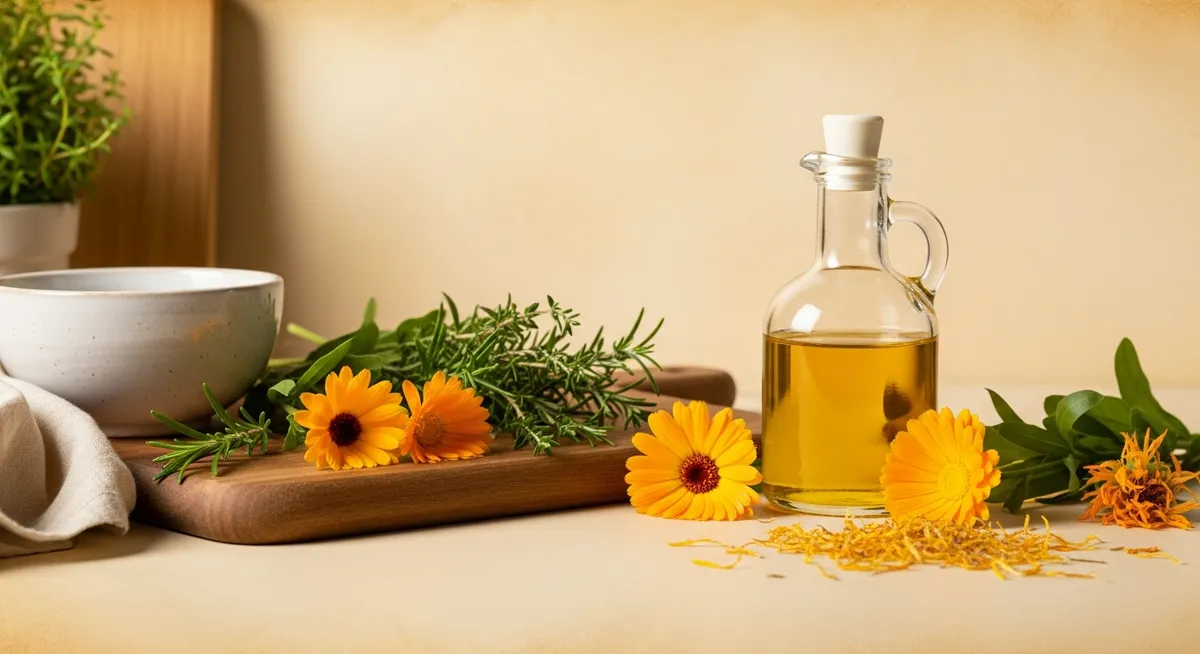
Calendula Oil After Sun: Why a Spray Recipe Is the Wrong Idea
People ask us for an after-sun spray recipe, and we have decided not to write one. A spray means adding water to oil, water changes what the product is, and the sunburn evidence for calendula is thinner than any recipe card admits. We make a calendula oil, so here is the reasoning behind that call, what dermatologists advise for a sunburn, and the one narrow way we would use our oil after a day outdoors.

Calendula Oil
Our own small-batch calendula oil, in sizes from 0.5 oz to bulk.
From $13.99
Shop Calendula Oil →Start with what the dermatologists put on the list
The American Academy of Dermatology (AAD) sunburn page opens with getting out of the sun, preferably indoors. Then it lists frequent cool baths or showers, patting dry gently, and applying a moisturizer with aloe vera or soy while the skin is still damp. It also mentions calamine lotion, a cool damp washcloth, a colloidal oatmeal bath, aspirin or ibuprofen for swelling and discomfort, and extra water, since a sunburn pulls fluid toward the skin's surface. Blisters mean a deeper burn: the AAD says not to pop them and to keep them clean and covered with petroleum jelly. For further questions it points to a board-certified dermatologist.
Calendula is not on that list, and neither is a homemade spray. We would rather say that plainly than build a recipe around a gap.
What the evidence says about calendula and sun
We searched for a human trial of calendula on sunburn and found none. What exists is adjacent, and most of it is not about oil on skin:
- The EU herbal medicines committee names sunburn only as an example inside its traditional-use wording for minor skin inflammation, a category based on long-standing use rather than clinical trials (EMA/HMPC, 2018). The forms it lists are comminuted flower for dressings and semi-solid products at 2-8% herbal substance for the oil extract, not a spray.
- Laboratory work has measured in vitro SPF values for calendula essential oil: 8.36 in a 2019 study (Lohani et al., J Cosmet Dermatol, 2019) and about 14.8 for a cream containing it in 2012 (Mishra et al., J Young Pharm, 2012). These are spectrophotometer estimates on steam-distilled oil. Ours is an infused oil, a different material, and neither study involved human skin.
- In a 2010 mouse study, calendula extract given orally kept skin glutathione levels near normal after UVB exposure (Fonseca et al., J Ethnopharmacol, 2010). It tested neither skin application nor human sunburn.
The honest summary: nobody has shown that calendula oil does anything for a sunburn, and nothing here shows it shields skin from the sun. That second point matters more. The FDA regulates sunscreens as over-the-counter drugs, with SPF set by standardized testing. A 2019 study of popular online homemade-sunscreen recipes found that most would give insufficient UV protection (Merten et al., Health Communication, 2019, as summarised by Nationwide Children's Hospital). Our oil has no tested SPF and we state none. See calendula oil and SPF for that question on its own.
Why the spray bottle is the problem
Pure calendula oil is oil; there is no water in it. A spray usually means mixing it with something watery, such as aloe juice, a floral water or a cooled tea, because plain oil can be awkward to mist (our reasoning, not a sourced limit). That is where we get off the bus, for two reasons.
- Water brings microbes. A 2018 review states that cosmetics containing water require preservation against microbial contamination, verified for example by challenge testing (Halla et al., Molecules, 2018). The FDA's cosmetics inspection manual says the agency is concerned that products labelled "natural" or "no preservatives" may not be safe without appropriate safety testing (FDA CPG 7329.001, 2016). A kitchen-made water-and-oil spray has neither preservation nor a challenge test, and burned skin is the last place to apply a contaminated product.
- It changes our product into one we cannot vouch for. When we make the oil we add no preservatives, tocopherol or stabilizers, because an anhydrous oil does not call for them. Add water and that logic no longer holds. We would be handing you a product with unknown keeping time, based on a base we have no data on.
A further reasoning point: sunburned skin hurts to touch, and a spray is attractive for that reason. But the dermatologist advice above achieves the same no-rubbing goal with cool water and a pat-dry, with nothing to spoil.
The narrow way we would use the oil
If the skin is only dry and tight after time outdoors, with no blisters, no heat radiating from it and no fever, the question becomes about moisture rather than burn. The AAD's own technique is moisturizer on damp skin. Reasoning from that, a few drops of an oil spread over still-damp skin after a cool shower fits the same pattern. This is our inference, not a studied use of our oil, and these limits apply:
- Intact skin only. Not on blisters, peeling that has opened, or any area that is weeping.
- Patch test first. Calendula is in the daisy (Asteraceae) family, and the EU monograph lists hypersensitivity to those plants as a contraindication. In one patch-test series of 443 dermatitis patients, about 2% reacted to marigold (Reider et al., Contact Dermatitis, 2001). Reddened, tender skin makes a reaction harder to spot, so test on your forearm days before the beach. Our patch test guide shows how.
- Children and pregnancy. The monograph does not recommend skin use under age 6 and says safety in pregnancy and lactation is not established. Ask a pediatrician or an OB/GYN or midwife.
- Go to a clinician for blisters, for a burn that is not improving, or if you feel unwell. Sunburn is a burn, and the AAD points questions about it to a board-certified dermatologist.
For how this compares to the plant most people reach for first, see calendula oil vs aloe vera for sunburn, and for our wider take on sun and calendula, calendula oil for sunburn.
What we can tell you about the oil
We buy dried Calendula officinalis flowers, organically grown on family farms, and make the oil in-house: calendula is extracted on its own, then brought into a carrier oil, which we do not name on the site (email us and we will give you the carrier on the batch paperwork). Every batch is tested by independent third-party labs, bottles are dated and lot-numbered, and the batch documentation is available when you email the lot number to [email protected]. How it behaves on sun-exposed skin is outside what we can claim.
Calendula Oil
Nature's Golden Botanical, bottled: small-batch calendula oil in sizes from 0.5 oz to bulk.
From $13.99
Shop Calendula Oil →Sources & Further Reading
- American Academy of Dermatology. How to treat sunburn. aad.org, sunburn page
- European Medicines Agency, HMPC, 2018. European Union herbal monograph on Calendula officinalis L., flos (EMA/HMPC/437450/2017). ema.europa.eu
- Lohani A et al., 2019. Cosmeceutical potential of geranium and calendula essential oil: antioxidant activity and in vitro sun protection factor. J Cosmet Dermatol 18(2):550-557. pubmed.ncbi.nlm.nih.gov/30251317
- Mishra A et al., 2012. Assessment of in vitro sun protection factor of Calendula officinalis L. essential oil formulation. J Young Pharm 4(1):17-21. pubmed.ncbi.nlm.nih.gov/22523455
- Fonseca YM et al., 2010. Protective effect of Calendula officinalis extract against UVB-induced oxidative stress in skin. J Ethnopharmacol 127(3):596-601. pubmed.ncbi.nlm.nih.gov/20026397
- U.S. Food and Drug Administration. Sunscreen: how to help protect your skin from the sun. fda.gov, sunscreen page
- Merten JW et al., 2019. Homemade sunscreen recipes on Pinterest (Health Communication); Nationwide Children's Hospital news release, May 2019. nationwidechildrens.org
- Halla N et al., 2018. Cosmetics preservation: a review on present strategies. Molecules 23(7):1571. pubmed.ncbi.nlm.nih.gov/29958439
- U.S. Food and Drug Administration, 2016. Compliance Program Guidance Manual 7329.001, Cosmetics Program, Chapter 29. fda.gov/media/78441
- Reider N et al., 2001. The seamy side of natural medicines: contact sensitization to arnica and marigold. Contact Dermatitis 45(5):269-272. pubmed.ncbi.nlm.nih.gov/11722485