
Calendula in Korean Skincare: K-Beauty Ingredient Spotlight
A calendula ingredient on a Korean toner, essence or pad is usually a different material from the golden oil we make. The two share a plant, Calendula officinalis, and almost nothing else that matters for how you use them. We make one product, an infused oil, so this piece is about reading the label correctly rather than selling you a K-beauty story.
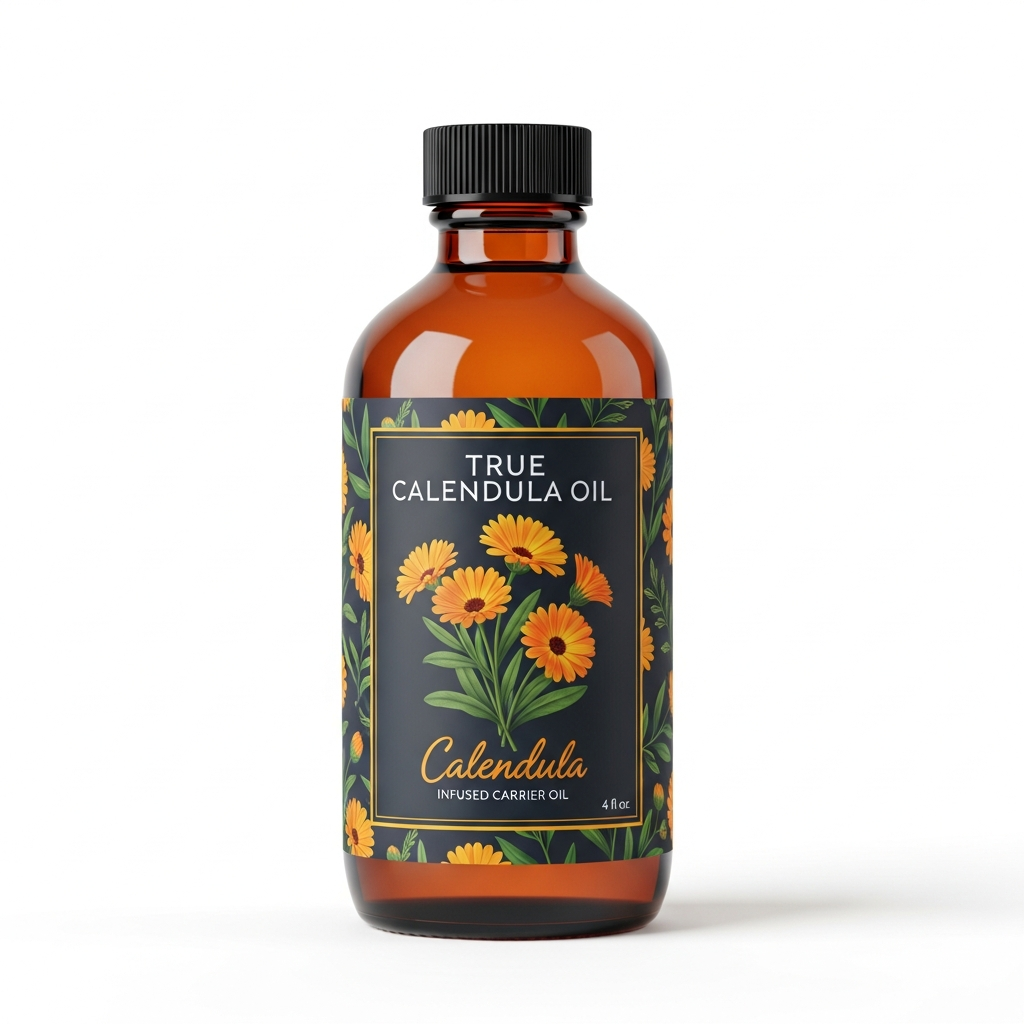
Calendula Oil
Our own small-batch calendula oil, in sizes from 0.5 oz to bulk.
From $13.99
Shop Calendula Oil →Start with what we could not verify
The old version of this article claimed calendula is a rising staple in Seoul's beauty labs. We went looking for a journal article or market report that documents that and found none. Search results did list calendula-extract toners and pads from Korean brands, but they were retailer listings and ingredient-database pages, and we were unable to open the brand pages to read a label ourselves. So we name no products, quote no concentrations from them, and make no claim about how common calendula is in Korean skincare. Everything below is about the ingredient, not the trend.
Extract and infused oil are different ingredients
On an ingredient list, an infused oil can appear as the carrier oil plus "Calendula Officinalis Flower Extract." One commercial calendula macerate's data sheet, for example, declares Helianthus Annuus Seed Oil, Calendula Officinalis Flower Extract and Tocopherol (Golgemma technical data sheet FB026, 2025). So the same INCI name can sit on a toner that is mostly water and on an oil that is mostly carrier. The name alone does not tell you how much calendula is in the bottle, and, as the Altmeyers encyclopedia entry on the INCI name notes, an oil version is an extract of the flowers made using a vegetable oil.
Here is the chemistry that follows. Calendula flowers contain saponins, flavonoids and polysaccharides that are water-soluble, and carotenoids and triterpene esters that are fat-soluble. A 2022 phytochemical review (Olennikov and Kashchenko, Molecules) records the polysaccharide work as done on water or alkali extracts of flowers, and the EU assessment report describes the saponins as glycosides. Reasoning from that, not from a measurement of any particular product: a water-based extract in a toner and an oil infusion carry different parts of the flower. Nobody we found has published an analysis of what ends up in an infused oil versus a toner extract, so treat any brand's statement that its product has "all of calendula" with caution, including ours.
The fat-soluble side is where our oil sits. In a 2025 Nature Communications study (Golubova et al.), faradiol myristate and palmitate in ray florets measured about 13.2 and 12.5 mg per gram dry weight. That paper measured petals, not oil. It does not show how much transfers into an infusion.
What the trials say about calendula in a water-based or cream format
Water-based K-beauty formats like toners and essences are the closest analogue to the extract-in-a-vehicle trials, so those are the studies worth knowing, with their limits:
- In a 2025 double-blind study of 20 healthy volunteers with chemically induced skin irritation, Crnčević et al. (Acta Pharm) reported higher skin hydration at forearm sites treated with an emollient cream containing 1% supercritical CO2 calendula extract than at placebo-cream or untreated sites on day 4. That is a CO2 extract in a cream, on forearms, in 20 people.
- In an 8-week study of 21 healthy volunteers, Akhtar et al. (Acta Pol Pharm, 2011) found two of seven cutometer skin-mechanics measurements differed significantly between a calendula-extract cream and a base cream. The study did not assess wrinkles.
- A 2015 review of herbal anti-aging creams, which included calendula, concluded that evidence-based studies of anti-aging effects are still needed (Jadoon et al., 2015).
None of these tests a Korean product, a toner, or an infused oil. If a label implies the ingredient does something specific, ask what the concentration was and what vehicle it was tested in.
What a layered routine changes, and what it does not
A layering routine tends to put water-based steps first and a sealing step last. That ordering makes sense for an oil, and there is one point worth correcting about pH, which comes up often around layering. pH describes water-based solutions: an all-oil formulation does not contain water and so does not have a pH in the usual sense (My Skin Recipes expert Q&A, 2019, a trade source). Skin's own surface pH averages about 4.7 in a 330-person study (Lambers et al., Int J Cosmet Sci, 2006), and the same paper found soap and tap water raise it temporarily. A review puts conventional soap at pH 8.5-11 against skin at about 4-6 (Bohbot et al., 2025). The practical consequence: the cleanser you choose affects skin pH far more than an oil placed after it. Our oil is not a pH product, and we do not state a pH for it.
Two questions that work on any calendula label
First, is it an extract in water or glycol, a CO2 extract, or an oil infusion? The trials above used a CO2 extract at 1% in one case and unspecified extracts in the other. Second, what does the label claim? In the United States, FDA treats a product as a drug when it is intended to affect the body's structure or function or to address disease (FDA, Cosmetics & U.S. Law), and it has sent warning letters over calendula product claims about skin conditions (2017). A label that stays with cosmetic language is a good sign about the seller, not about the formula.
Who should skip it, in either format
Calendula belongs to the Asteraceae family, and the EU herbal monograph lists hypersensitivity to Asteraceae plants as a contraindication and notes skin sensitization has been reported, frequency unknown (EMA/HMPC, 2018). The same monograph says safety in pregnancy and breastfeeding has not been established and does not recommend use under age 6 on skin. A fragrance-free, minimal product is not automatically safer for an allergic person. If you react to chamomile, ragweed or chrysanthemum, ask a dermatologist or allergist before adding any calendula product, toner or oil.
If you want to try our oil as the sealing step of a routine you already use, read how to use calendula oil in an oil cleansing routine and how to patch test it first, and note that the comedogenic question depends on the carrier. For a closer look at what is and is not in an infused oil, see infused oil vs essential oil. Where our flowers come from is on our sourcing page.
Calendula in a Korean toner and calendula in our oil are two separate decisions. If you are curious about the oil, buy the smallest size and run the patch test before it goes anywhere near your routine.
Calendula Oil
Nature's Golden Botanical, bottled: small-batch calendula oil in sizes from 0.5 oz to bulk.
From $13.99
Shop Calendula Oil →Sources & Further Reading
- Golgemma (Biolandes), 2025. Technical data sheet, Calendula Org Macerate/Oil FB026. biolandes.com/FB026
- Altmeyers Enzyklopädie, 2025. Calendula officinalis oil (INCI). altmeyers.org/29469
- Olennikov DN, Kashchenko NI, 2022. Marigold metabolites: diversity and separation methods of Calendula genus phytochemicals. Molecules 27(23):8626. PMC9736270
- Golubova D et al., 2025. Biosynthesis and bioactivity of anti-inflammatory triterpenoids in Calendula officinalis. Nature Communications. PMC12304140
- Crnčević MŠ et al., 2025. Double-blind randomised controlled trial of an emollient cream with and without 1% supercritical CO2 extract of Calendula officinalis in contact dermatitis. Acta Pharm. pubmed/41527980
- Akhtar N et al., 2011. Calendula extract: effects on mechanical parameters of human skin. Acta Pol Pharm 68(5):693-701. pubmed/21928714
- Jadoon S et al., 2015. Anti-aging potential of phytoextract loaded-pharmaceutical creams. Oxid Med Cell Longev. pubmed/26448818
- My Skin Recipes, 2019. pH adjustment in formulations (expert Q&A). myskinrecipes.com
- Lambers H et al., 2006. Natural skin surface pH is on average below 5. Int J Cosmet Sci 28(5):359-370. pubmed/18489300
- Bohbot JM et al., 2025. Vulvar care: reviewing concepts in daily hygiene. Healthcare 13(13):1523. PMC12248671
- EMA/HMPC, 2018. European Union herbal monograph on Calendula officinalis L., flos. EMA/HMPC/437450/2017. ema.europa.eu
- FDA. Cosmetics & U.S. Law. fda.gov
- FDA, 2017. Warning letter to Be Natural Organics (MARCS-CMS 523615). fda.gov/523615