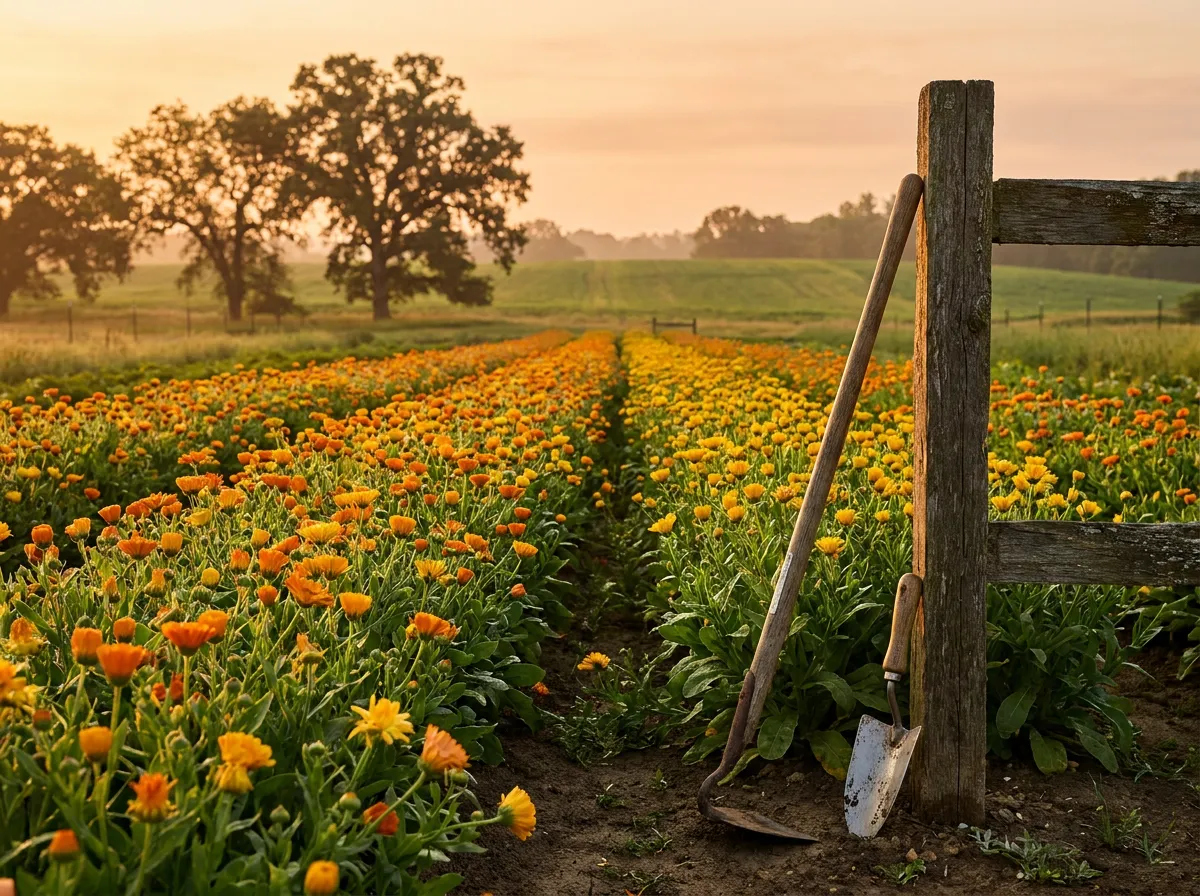
Four growing regions. Family farms we have worked with for over a decade. One flower, handled the way it should be.
Calendula is one of the most trusted flowers in skincare, and one of the most carelessly made.
Most of what reaches shelves moves through brokers who cannot name the country the flowers grew in, let alone the farm. The flowers are dried fast and hot, because fast and hot is cheap. What ends up in the bottle is technically calendula, and not much of it.
We built True Calendula Oil to do one thing properly instead of a dozen things adequately.
We make calendula oil. That's all we make. Every flower we use is grown organically on family farms across four regions, harvested by people whose families have grown this crop for generations, and dried by traditional methods rather than industrial heat. We handle production ourselves, so nothing passes through a stage we can't account for.
Ten years of the same relationships, one crop, and no shortcuts. That's the whole business.
Calendula grows well in more than one place, and each region brings its own timing, soil, and growing tradition. Rather than tie ourselves to a single source, we work with organic family farms across four. Organically grown, here, means what it sounds like: no synthetic pesticides and no synthetic fertilizers, on farms that have refined their methods across generations.
Long, generous growing seasons and a deep agricultural tradition in flower cultivation.
Central European farmland with a long history of medicinal herb growing.
Smallholder farms working land that has grown botanicals for generations.
Family operations in regions where flower cultivation is a multigenerational trade.
We don't buy from commodity brokers or anonymous wholesale lots. Every farm we work with is a family operation, growing organically, using practices their families have refined over generations.
We've worked with these same growers for over a decade. That's long enough to know how each of them farms, how each season went, and what to expect from a harvest before it arrives. It's a relationship rather than a purchase order, and it's the reason our oil is consistent year after year in a category where consistency is rare.
Calendula doesn't follow a calendar you can set from an office. Each region blooms on its own schedule, and the right week to pick in Egypt is not the right week in Hungary.
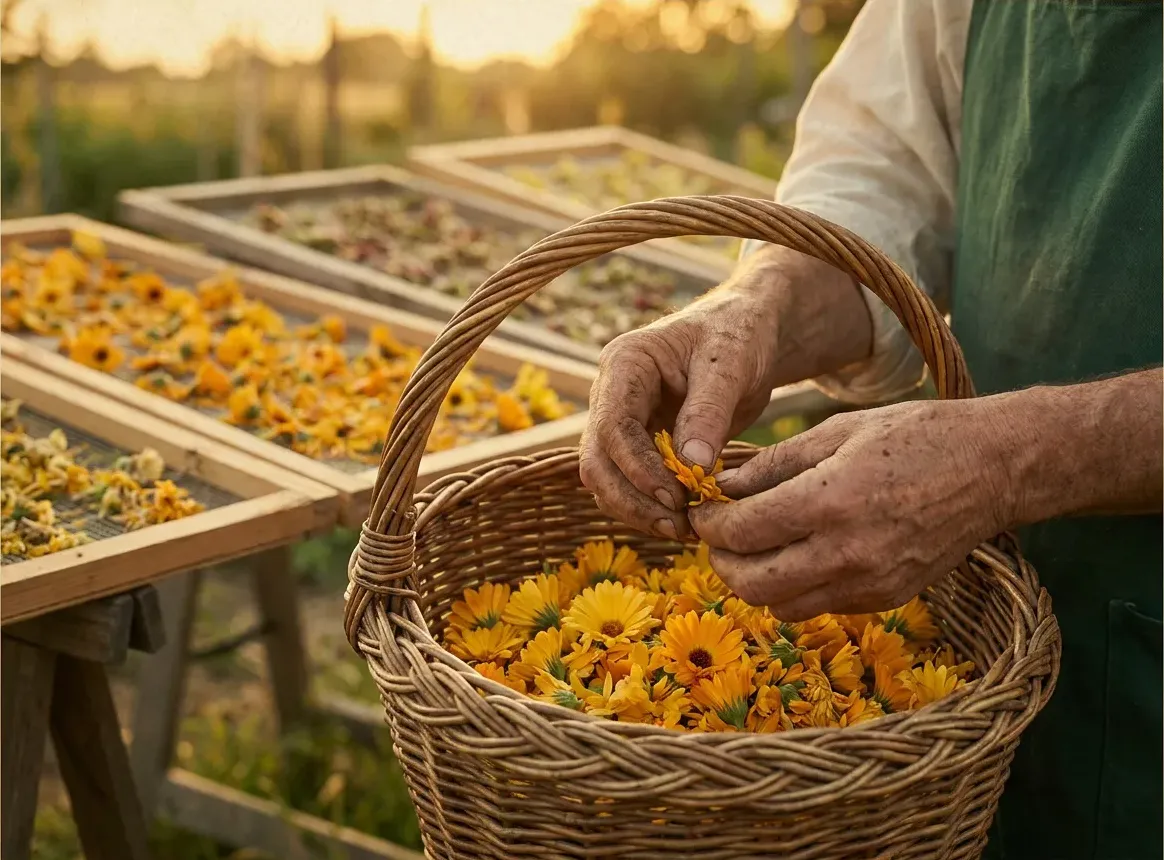
So we don't dictate harvest timing. Our farmers pick when their own fields are at their best, at full bloom, in the window their families have picked in for generations. They know their land better than any schedule we could impose on it.
We infuse the petals, separated by hand from sound, whole-dried flower heads rather than swept up as broken florets.
Drying is done naturally, by traditional methods, without industrial heat or forced-air processing. That's slower and it takes more space, but heat is what damages calendula. Flowers rushed through high-temperature drying lose color and character before they ever reach production, and color, in calendula, is not decoration. It's the most visible evidence of how carefully the flowers were handled.
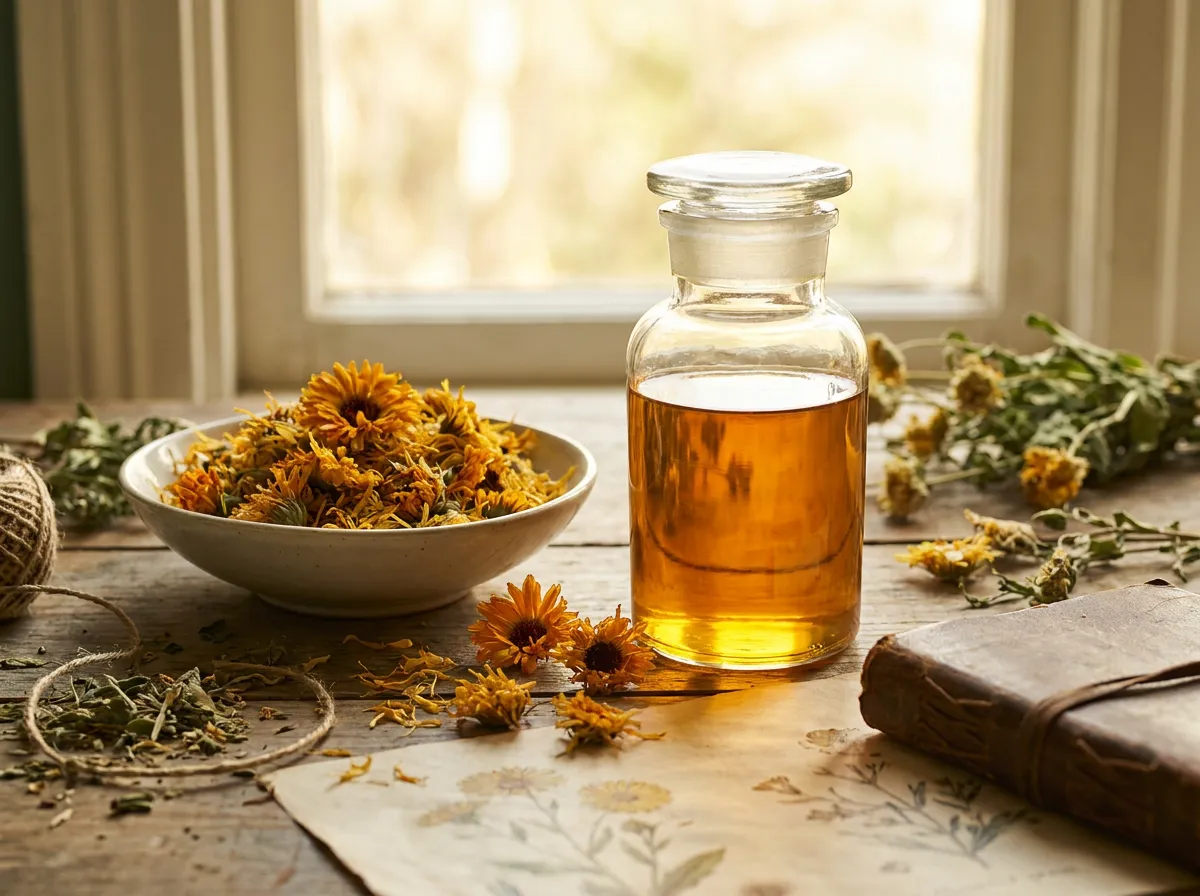
We buy flowers. We don't buy finished oil.
That distinction matters more than it sounds. Most brands selling calendula oil are relabeling something produced by a third party, which means they're trusting a supplier's word about everything that happened before the drum arrived. We handle production ourselves, so every stage between the dried flower and the sealed bottle is ours to answer for.
Our process runs in two stages. First we extract the calendula itself. Only calendula flowers go into that extraction, nothing blended in, no other botanicals, no cheaper oils standing in for part of the batch. What comes out is calendula and calendula alone.
Second, we bring that extract into a carrier oil to make the finished product you use on your skin. Calendula extract is intense and isn't meant to be applied undiluted, so the carrier isn't a way of stretching the bottle. It's what makes the oil usable, and it's how calendula oil has been prepared for as long as people have been making it.
Two stages, both done by us, with a single flower going in at the start. That's what we mean when we say true calendula oil.
Every batch is tested by independent, third-party laboratories with no financial relationship to us or to our growers.
Confirming the oil's fundamental characteristics match what genuine calendula oil should be.
Verifying composition, so that what's in the bottle is what the label says it is.
Checking for residues and impurities, because organic growing is a standard that deserves to be confirmed rather than assumed.
The flowers themselves come from farms growing organically, and our independent testing confirms that standard held all the way through to the finished oil.
Batch documentation is available on request. Email the lot number from your bottle to [email protected] and we'll send you the paperwork for it, or get in touch here.
Every bottle carries its production dates and lot number, not a vague best-by stamp with nothing to reference it against. If you want to know when your oil was made and where its flowers came from, the information is on the label and the records are on file.
We bottle in top-grade glass across every size we offer, from the smallest bottle to the largest.
No synthetic preservatives, no added tocopherol, no stabilizers. Stored properly, the oil keeps without them.
Sustainability, for us, isn't a program we added to the business. It's what buying from decade-old family farms actually looks like in practice.
The farms we work with grow organically, with no synthetic pesticides and no synthetic fertilizers, using methods refined across generations on the same land. Traditional drying uses no industrial energy input. Production is small-scale and deliberate, because we make one product and have no reason to push volume beyond what our growers can supply well.
These farmers have every incentive to keep their land productive. It's the land their families will still be farming in twenty years, and that's a stronger guarantee than any pledge we could write on a website.
Six standards we hold ourselves to on every bottle we sell.
We make calendula oil and nothing else. All of our attention goes into a single crop.
Every flower comes from a family-run farm growing organically, across four regions we've sourced from for over a decade.
Naturally dried by generational methods, with no industrial heat to strip the flowers before production begins.
We buy flowers, not finished oil. Production is ours from dried flower to sealed bottle.
Physical, chemical, and contaminant assays by third-party laboratories with no stake in the outcome.
No synthetic preservatives, no stabilizers, no fillers. Top-grade glass, dated and lot-numbered.
We'd rather be plain about the limits.
We don't make medical claims. Calendula has a long traditional record and an active research literature. We'll point you to both. We won't tell you what it will do for you.
Calendula belongs to the Asteraceae family, alongside daisies, chrysanthemums, ragweed, and marigolds. If you're sensitive to those, patch test first and skip it if you react.
We don't sell what we can't account for. If a season goes badly and we can't source flowers that meet our standard, we run out. We'd rather be out of stock than quietly lower the bar.
Organic family farms, four regions, a decade of the same relationships, independently tested, and dated on the bottle.
Start with the color.
Shop Calendula Oil