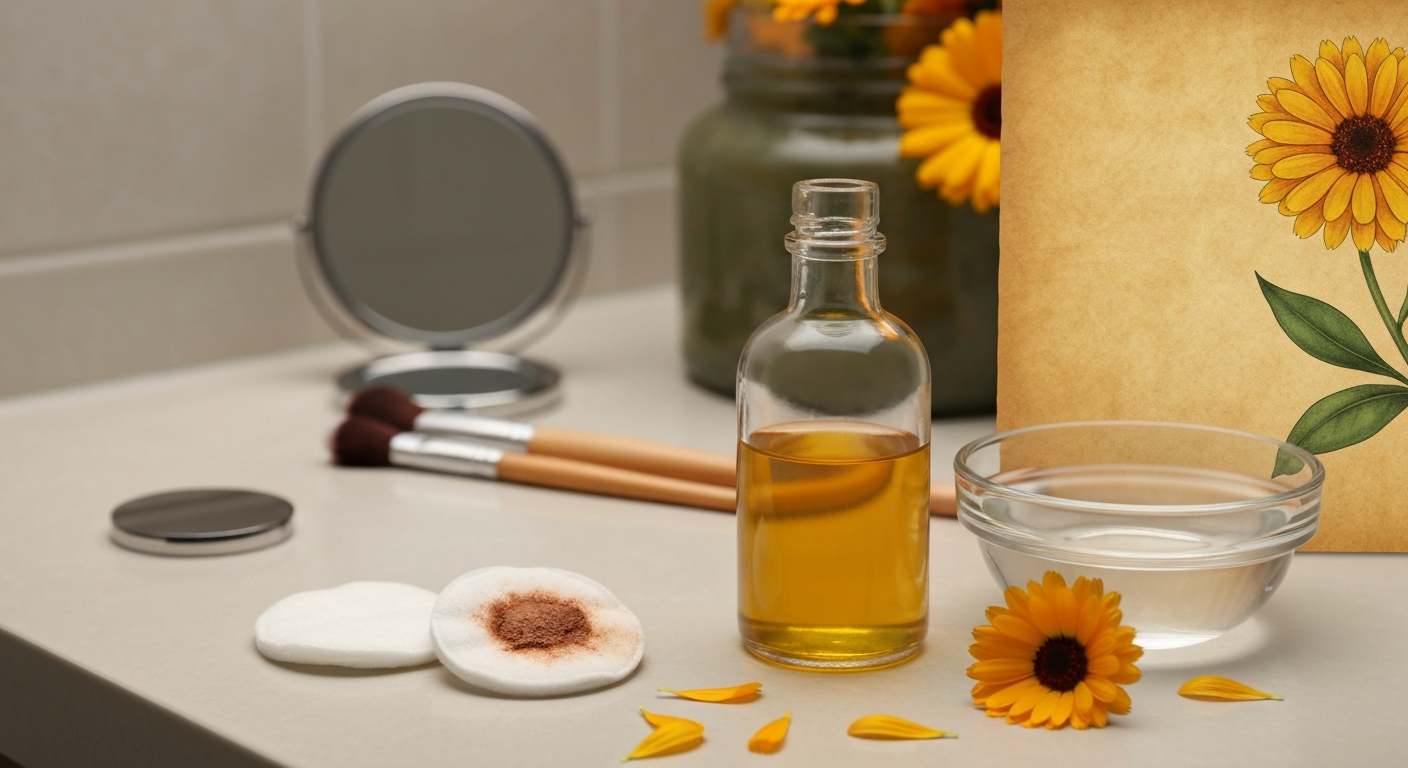
How to Use Calendula Oil as a Makeup Remover: A Gentle, Natural Cleansing Method
Calendula oil can be used as a makeup remover, and the method is the same as for any plain cosmetic oil: oil on dry skin, a warm damp cloth, rinse. What deserves your attention is not the technique but three things around it: the eyes, the bottle you are pouring from, and whether you break out. I will take those in the order I would raise them if you asked us about it.

Calendula Oil
Our own small-batch calendula oil, in sizes from 0.5 oz to bulk.
From $13.99
Shop Calendula Oil →First decision: do you want it near your eyes?
Most makeup removal is eye makeup, so this comes first. The Cosmetic Ingredient Review expert panel's 2010 assessment concluded that calendula-derived cosmetic ingredients, including the flower oil, are safe in cosmetics at the concentrations and practices of use it reviewed. It also found them not irritating, sensitizing or photosensitizing in animal or clinical tests, but said they "may be mild ocular irritants" (Andersen et al., Int J Toxicol, 2010). That is the only eye-specific statement we could source, and it is a reason for care, not alarm.
Reasoning from it, my advice is to try the oil on the cheeks and forehead first. If your skin is fine with it after a few days, move to the eyelids, using a very small amount on a pad with your eyes closed, and do not press oil toward the lash line. If you feel stinging or blurred vision, rinse with plenty of clean water, stop using it near the eyes, and see an eye doctor if it does not clear. Take out contact lenses before you begin; this is a precaution, not a sourced rule, and an optometrist is the person to ask about oils and lenses.
The published calendula studies are of no help here: most calendula trials used extracts in creams or ointments, not an infused oil around the eyes. If you have had any eye irritation from cosmetics before, skip it and ask an ophthalmologist or optometrist.
The routine, step by step
This is our walkthrough, built from the usual oil-cleansing method and the cautions above. It is not drawn from a trial.
- Start with dry hands and a dry face. Water on your hands or face is what tends to end up in the bottle and on the cotton.
- Pour a small amount into your palm rather than dipping a cotton pad into the bottle. A few drops is enough for a first try; add more only if the makeup is stubborn.
- Warm it between your fingers and press it over the skin, using small circles for a minute or so to loosen the makeup.
- For the eyes, use a clean pad or the clean tip of a finger with your eyes closed. One slow sweep is better than scrubbing.
- Take it off with a warm damp cloth and rinse the cloth between passes. Wash the cloth after use.
- Follow with whatever you normally wash with if your skin feels coated. How much residue you are left with depends on your skin and your makeup, and we have no data on it.
The bottle: keep water and dirty fingers out of it
Our oil has no synthetic preservatives, no added tocopherol and no stabilizers. That is deliberate and it has a consequence for how you handle the bottle. The 1995 review of cosmetic preservation in the Journal of the Society of Cosmetic Chemists says the products that most need preservatives are those containing water, and that "the only limit to microbial life is the availability of liquid water" (Brannan, J Soc Cosmet Chem, 1995). An oil has little of it, which is its advantage, and a wet cotton pad dipped into the bottle gives it some.
The eye area is where this matters most. An FDA inspection manual says the agency samples eye-area cosmetics for microbiological analysis when preservation is in doubt or non-traditional systems are used, and that it is concerned about products labeled "natural" or "no preservatives" that lack safety testing (FDA Compliance Program Guidance Manual 7329.001, 2016). FDA also names contaminated water and raw materials as sources of contaminated cosmetics and says to wash your hands before putting fingers into a container (FDA, Microbiological Safety and Cosmetics). So pour, do not dip; keep the cap on; and use the bottle within a sensible time of opening. We do not publish a shelf-life figure for our oil, so write the date you opened it on the bottle, next to our own date and lot number.
"Will it make me break out?"
We cannot tell you. Reasoning from the literature, the answer for any oil is uncertain. Many comedogenic lists come from rabbit-ear assays such as Fulton's 1984 work, whose authors called the model "not an ideal animal model" (Fulton et al., J Am Acad Dermatol, 1984). A small human study of six volunteers concluded that finished products using comedogenic ingredients are not necessarily comedogenic (Draelos and DiNardo, J Am Acad Dermatol, 2006). Neither study tested our oil, and the abstracts do not list a calendula result. If you break out easily, test on a small area for a couple of weeks before you commit, and see a dermatologist if breakouts are a regular problem. Our posts on comedogenicity and the oil cleansing method cover the longer-term question.
Who should not use it this way
Calendula is in the daisy family (Asteraceae). The EU herbal monograph lists hypersensitivity to Asteraceae plants as a contraindication, notes that skin sensitization has been reported (frequency not known), and does not recommend skin use under age 6 (EMA/HMPC, 2018). In one Austrian study of 443 dermatitis patients, 9 (about 2%) reacted to a marigold test preparation (Reider et al., Contact Dermatitis, 2001). Those were patients being tested for dermatitis, not a random sample.
On the face, skin is thin and a reaction shows. Do a small-area test first: dermatologists who use a repeated open application test most often apply twice daily to the forearm for one to two weeks, with no standard method established (Brown et al., Dermatitis, 2015). Our patch test post covers how. If you react, FDA advises stopping the product and calling a healthcare provider (FDA, Using Cosmetics Safely). Anyone with a known ragweed, chamomile or daisy-family allergy should ask an allergist before using it, and anyone with active dermatitis near the eyes should ask a dermatologist.
Whether it is the right tool
An oil is a cleanser only in the sense that it dissolves oily makeup; it does not replace washing. We have no data on how an oil removes sunscreen or long-wear makeup, so judge that by how your skin looks and feels afterward. For a plain skin routine, the morning and night routine post sets out where an oil sits, and the face FAQ answers the basic questions.
If you want to try ours, a small bottle is the sensible start: the 0.5 oz or 1 oz on the shop page is enough to run a patch test and a week of use before you decide.
Calendula Oil
Nature's Golden Botanical, bottled: small-batch calendula oil in sizes from 0.5 oz to bulk.
From $13.99
Shop Calendula Oil →Sources & Further Reading
- Andersen FA et al., 2010. Final report of the Cosmetic Ingredient Review Expert Panel amended safety assessment of Calendula officinalis-derived cosmetic ingredients. Int J Toxicol 29(6 Suppl):221S-43S. pubmed.ncbi.nlm.nih.gov/21164072
- Brannan DK, 1995. Cosmetic preservation. J Soc Cosmet Chem 46:199-220. library.scconline.org/Cosmetic-Preservation
- U.S. FDA, 2016. Compliance Program Guidance Manual 7329.001, Cosmetics Program, Chapter 29. fda.gov/media/78441
- U.S. FDA. Microbiological Safety and Cosmetics. fda.gov/microbiological-safety-and-cosmetics
- Fulton JE Jr et al., 1984. Comedogenicity of current therapeutic products, cosmetics, and ingredients in the rabbit ear. J Am Acad Dermatol 10(1):96-105. pubmed.ncbi.nlm.nih.gov/6229554
- Draelos ZD, DiNardo JC, 2006. A re-evaluation of the comedogenicity concept. J Am Acad Dermatol 54(3):507-12. pubmed.ncbi.nlm.nih.gov/16488305
- EMA/HMPC, 2018. European Union herbal monograph on Calendula officinalis L., flos (Revision 1), EMA/HMPC/437450/2017. ema.europa.eu/EMA/HMPC/437450/2017
- Reider N et al., 2001. The seamy side of natural medicines. Contact Dermatitis 45(5):269-72. pubmed.ncbi.nlm.nih.gov/11722485
- Brown GE et al., 2015. Clinical utilization of repeated open application test among American Contact Dermatitis Society members. Dermatitis 26(5):224-9. pubmed.ncbi.nlm.nih.gov/26367205
- U.S. FDA. Using Cosmetics Safely. fda.gov/using-cosmetics-safely