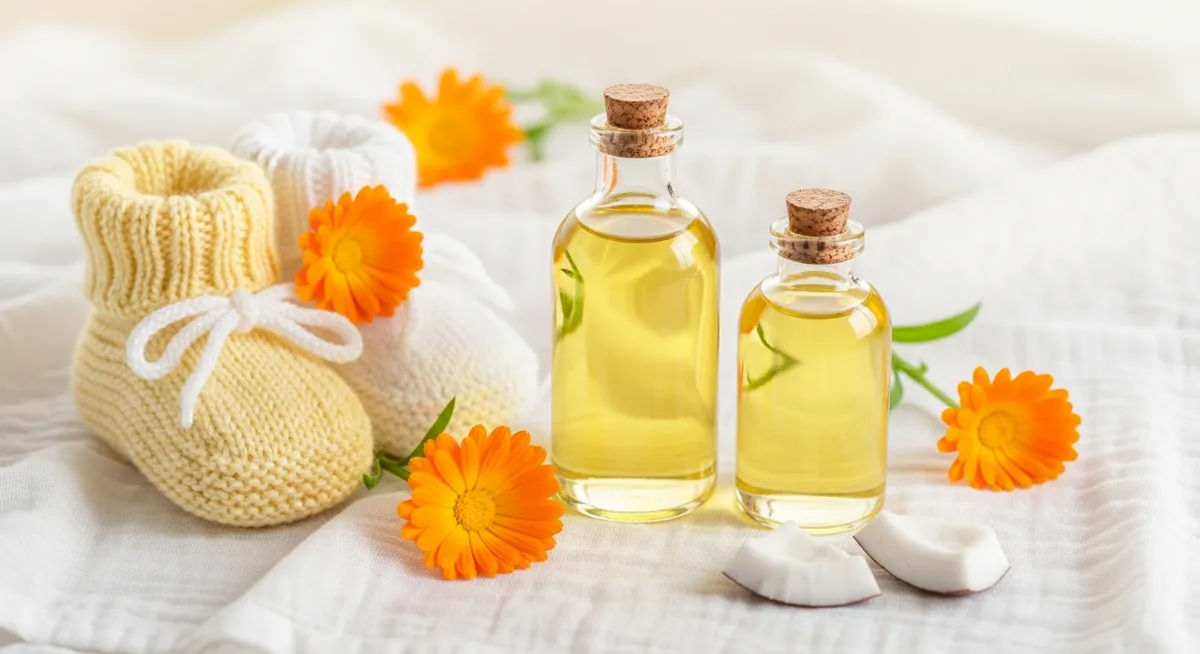
Calendula Oil vs Coconut Oil on Baby Skin: What the Data Show
Calendula oil and coconut oil are not rivals for baby skin, because neither has been shown to do what the comparison implies. The better first question is whether a healthy baby needs any oil at all, and the published answer is less settled than most baby-care pages suggest. We make an infused calendula oil, and we do not call it "baby safe": the published record does not support that phrase for any plant oil, ours included.

Calendula Oil
Our own small-batch calendula oil, in sizes from 0.5 oz to bulk.
From $13.99
Shop Calendula Oil →Start with the baby, not the oil
The one randomized trial that asked the plain question in healthy newborns found reasons for caution. In a 2016 pilot, 115 healthy full-term neonates were assigned to olive oil, sunflower oil or no oil, twice daily for 4 weeks. Both oil groups had better skin hydration, but they showed significantly less improvement in lipid lamellae structure (the ordered fat layers of the skin barrier) than the no-oil group, and there were no significant differences in water loss, pH or redness. The authors wrote that the study was not powered for clinical significance and that "caution should be exercised when recommending oils for neonatal skin" (Cooke et al., Acta Derm Venereol, 2016). Neither oil in that trial was coconut or calendula, so it does not rank our two candidates. It does show that "natural oil, therefore good for the barrier" is an assumption, not a result.
The neonatal-unit literature points the other way, with an important catch. A 2022 systematic review of 14 randomized trials (5,683 neonates, most of them preterm) found that 11 trials concluded oils improved skin condition or barrier function, 3 were equivocal, negative or mixed, and the authors still called for higher-quality studies (Aksucu et al., Adv Skin Wound Care, 2022). Reasoning from the population, preterm infants in a hospital are a different situation from a healthy term baby at home, so those results are not a recommendation for your nursery. A 2019 pediatric review adds that among infants with a family history of atopic dermatitis, regular application of bland moisturizers lowers the risk of developing it (Johnson and Hunt, Curr Opin Pediatr, 2019). "Bland" is the operative word, and which product to choose for your baby is a pediatrician's call.
What the coconut oil evidence actually covers
Coconut oil has the stronger pediatric dataset of the two, so it deserves a fair reading. In a 2014 double-blind trial of 117 children with mild to moderate atopic dermatitis, virgin coconut oil was compared with mineral oil for 8 weeks. Mean SCORAD scores fell 68.23% in the coconut group and 38.13% in the mineral oil group, with larger drops in water loss and gains in skin capacitance in the coconut group (Evangelista et al., Int J Dermatol, 2014). Two limits matter. The comparator was another oil, not a bland cream or no treatment, and the children already had a skin condition, so this is not evidence about routine care of healthy skin.
Chemistry explains why coconut oil behaves differently from a typical infused oil. A review of virgin coconut oil puts lauric acid at 46-48% on average, which is why it is solid below room temperature (Abdalla et al., ACS Omega, 2024). Some reviews also label coconut oil "highly comedogenic." That rating traces back to a rabbit-ear assay whose own author called it "not an ideal animal model" (Fulton et al., J Am Acad Dermatol, 1984), and a 2006 human study found that "finished products using comedogenic ingredients are not necessarily comedogenic" (Draelos and DiNardo, J Am Acad Dermatol, 2006). We would not choose or reject either oil for a baby on that rating.
What the calendula evidence covers, and what it does not
There is no trial of calendula oil on healthy baby skin. What exists is diaper-rash trials of ointments and creams, and they disagree:
- 66 infants, 2012: a calendula ointment (1.5% extract, per the EU assessment report) was followed by fewer rash sites than an aloe cream (P=0.001), with no placebo or untreated group (Panahi et al., ScientificWorldJournal, 2012).
- 100 infants, 2015: complete improvement within three days in 86% with a bentonite cream versus 52% with a calendula cream (Mahmoudi et al., Indian J Med Res, 2015).
- 73 children, 2018: 1.5% olive and 1.5% calendula ointments gave similar severity scores on days 3, 5 and 7 (Sharifi-Heris et al., Dermatol Ther, 2018).
None had an untreated arm, diaper rash often clears by itself, and none tested an infused oil. A 2023 systematic review of 17 herbal studies for children's skin, which included calendula, rated nearly half the studies low quality and highlighted other plants, not calendula (Kloter et al., Complement Ther Med, 2023).
The regulatory text is more direct. The EU herbal monograph says use of calendula flower preparations on skin in children under 6 "has not been established due to lack of adequate data" (EMA/HMPC, 2018). That is an absence of data, not a finding of harm, and it covers licensed medicines rather than cosmetics. The cosmetic safety panel's 2010 review judged calendula-derived ingredients safe in cosmetics "in the practices of use and concentration" it reviewed (Andersen et al., Int J Toxicol, 2010), and its index lists flower oil at up to 0.1% (CIR quick reference table). We cannot tell how the panel defined "flower oil," so we do not read that 0.1% as a rule for a bottle of infused oil used neat.
The allergy question comes first for a calendula product
Calendula is in the Asteraceae (Compositae) family, and the EU monograph lists hypersensitivity to that family as a contraindication. In one Austrian clinic series of 443 dermatitis patients, 9 (about 2%) reacted to a marigold patch-test preparation, which is a referred group and not a rate for babies (Reider et al., Contact Dermatitis, 2001). Coconut oil is not in that family. If a parent or sibling reacts to chamomile, ragweed or daisies, that history belongs in the pediatrician conversation before any calendula product goes on an infant. Our patch test walkthrough covers the adult routine; for an infant, ask the pediatrician how to test.
Reading a calendula baby oil label
Commercial products show how different "calendula baby oil" can be from a simple infused oil. Weleda's US page for its calendula baby oil lists sesame and sweet almond oils, calendula and chamomile extracts, and fragrance with limonene, linalool, geraniol and citral, and describes it as certified natural by NATRUE (Weleda US product page). We have not tested it. Reasoning from the label, it is a blend with several allergen-listed fragrance components and a second Compositae-family extract (German chamomile is among the Compositae plants studied for cross-reactions), which is a different risk profile from a single-plant infused oil. Our oil contains calendula and a carrier with nothing added; the carrier is named on the batch paperwork, which you can request by emailing the lot number to [email protected].
How we would sort the decision
| Situation | What the sources support | Who to ask |
|---|---|---|
| Healthy term baby, dry patches | Oils improved hydration but not barrier structure in one pilot trial; no calendula oil data | Pediatrician |
| Family history of atopic dermatitis | Bland moisturizers lowered risk in one review; no calendula data | Pediatrician or dermatologist |
| Diaper rash | Calendula ointment trials conflict, none had an untreated group | Pediatrician if it lasts or looks raw; see our diaper rash guide |
| Eczema in a child | Coconut oil beat mineral oil in one trial; calendula alone has no pediatric trial | Pediatric dermatologist; see calendula and eczema in children |
| Parent wants calendula anyway | EU monograph: not established under 6; allergy contraindication | Pediatrician before the first use |
The American Academy of Pediatrics makes the general point that therapies "are not safe just because they are natural" and advises checking with the child's doctor before adding one (AAP HealthyChildren.org, 2015). If a rash, redness or swelling appears after any oil, FDA's advice for cosmetics applies: stop the product and call a healthcare provider (FDA, Using Cosmetics Safely). Our broader baby safety FAQ goes through the questions parents ask most.
If you are an adult choosing between these two for your own skin, the question is different, and our oil is an option; for an infant, we would not make that choice for you, and neither oil is the answer to a baby's skin condition.
Calendula Oil
Nature's Golden Botanical, bottled: small-batch calendula oil in sizes from 0.5 oz to bulk.
From $13.99
Shop Calendula Oil →Sources & Further Reading
- EMA/HMPC, 2018. Assessment report on Calendula officinalis L., flos, EMA/HMPC/603409/2017. ema.europa.eu
- Paulsen E, Christensen LP, Andersen KE, 2008. Cosmetics and herbal remedies with Compositae plant extracts: are they tolerated by Compositae-allergic patients? Contact Dermatitis 58(1):15-23. pubmed.ncbi.nlm.nih.gov
- Cooke A et al., 2016. Olive Oil, Sunflower Oil or no Oil for Baby Dry Skin or Massage: A Pilot, Assessor-blinded, Randomized Controlled Trial (OBSeRvE). Acta Derm Venereol. pubmed.ncbi.nlm.nih.gov
- Aksucu G, Azak M, Caglar S, 2022. Effects of Topical Oils on Neonatal Skin: A Systematic Review. Adv Skin Wound Care 35(12). pubmed.ncbi.nlm.nih.gov
- Johnson E, Hunt R, 2019. Infant skin care: updates and recommendations. Curr Opin Pediatr 31(4). pubmed.ncbi.nlm.nih.gov
- Evangelista MT et al., 2014. The effect of topical virgin coconut oil on SCORAD index, transepidermal water loss, and skin capacitance in mild to moderate pediatric atopic dermatitis. Int J Dermatol. pubmed.ncbi.nlm.nih.gov
- Abdalla S, Aroua MK, Gew LT, 2024. A Comprehensive Review of Plant-Based Cosmetic Oils. ACS Omega 9:44019-44032. pmc.ncbi.nlm.nih.gov
- Fulton JE Jr et al., 1984. Comedogenicity of current therapeutic products, cosmetics, and ingredients in the rabbit ear. J Am Acad Dermatol 10(1):96-105. pubmed.ncbi.nlm.nih.gov
- Draelos ZD, DiNardo JC, 2006. A re-evaluation of the comedogenicity concept. J Am Acad Dermatol 54(3):507-512. pubmed.ncbi.nlm.nih.gov
- Panahi Y et al., 2012. A randomized comparative trial on the therapeutic efficacy of topical aloe vera and Calendula officinalis on diaper dermatitis in children. ScientificWorldJournal. pubmed.ncbi.nlm.nih.gov
- Mahmoudi M et al., 2015. Comparing the effects of bentonite and calendula on the improvement of infantile diaper dermatitis. Indian J Med Res 142(6):742-6. pubmed.ncbi.nlm.nih.gov
- Sharifi-Heris Z et al., 2018. Comparison the effects of topical application of olive and calendula ointments on children's diaper dermatitis. Dermatol Ther 31(6):e12731. pubmed.ncbi.nlm.nih.gov
- Kloter E et al., 2023. Phytotherapy in paediatric skin disorders: a systematic literature review. Complement Ther Med 74:102942. pubmed.ncbi.nlm.nih.gov
- EMA/HMPC, 2018. European Union herbal monograph on Calendula officinalis L., flos (Revision 1), EMA/HMPC/437450/2017. ema.europa.eu
- Andersen FA et al., 2010. Final report of the Cosmetic Ingredient Review Expert Panel amended safety assessment of Calendula officinalis-derived cosmetic ingredients. Int J Toxicol 29(6 Suppl). pubmed.ncbi.nlm.nih.gov
- Cosmetic Ingredient Review, 2017. Quick Reference Table: Review Conclusion (S-092016). cir-safety.org
- Reider N et al., 2001. The seamy side of natural medicines: contact sensitization to arnica and marigold. Contact Dermatitis 45(5):269-72. pubmed.ncbi.nlm.nih.gov
- Weleda US, accessed 2026-10-14. Comforting Baby Oil, Calendula (product page). weleda.com
- American Academy of Pediatrics, 2015. Natural Therapies and Children: FAQs. HealthyChildren.org. healthychildren.org
- FDA, accessed 2026-10-14. Using Cosmetics Safely. fda.gov