Calendula Oil Holiday Gift Guide: DIY & Store-Bought Ideas
The most important gift decision with calendula oil is made before you shop: whether the person on your list should be using it at all. Calendula is a daisy-family plant with a documented, uncommon allergy risk, and a gift removes the step where the recipient would have chosen it. This guide screens the recipient first, then walks through three routes, in rising order of effort: giving a bottle, turning a bottle into a salve, and infusing your own, with the quantities we can source and the ones you will have to decide yourself.

Calendula Oil
Our own small-batch calendula oil, in sizes from 0.5 oz to bulk.
From $13.99
Shop Calendula Oil →Screen the recipient first
Do not give calendula oil to someone who has told you they react to daisy-family plants. The EU herbal monograph lists hypersensitivity to Asteraceae (Compositae) plants as a contraindication and notes skin sensitization has been reported (EMA/HMPC, 2018). The same document says safety in pregnancy and breastfeeding has not been established and use is not recommended, and that skin use under age 6 is not recommended for lack of data. In practice that rules out a gift for a baby shower or a young child without a conversation with the parent first, and it makes "a pregnancy gift" a poor idea (see our pregnancy FAQ). If you are unsure, give a note instead of a bottle: it can say "ask me about this before you try it."
Also skip it as a medical gift. We make no medical claims for our oil, and a card promising it will help someone's eczema or sore joints is a claim that the trial literature does not support (our dermatitis piece lays out how thin that evidence is). Good gifts here are about pleasure and craft.
Route 1: give the oil itself
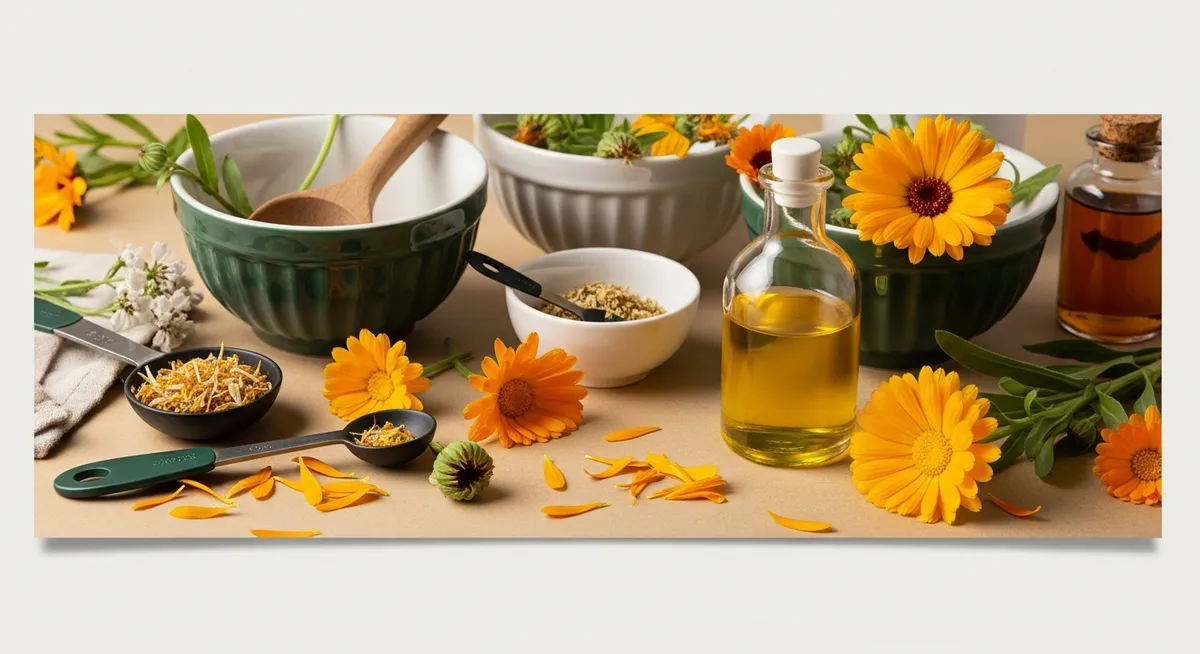
This is the lowest-effort way to give a good gift, because the infusion has already been done and documented. Our oil is a whole-flower infusion: organically grown Calendula officinalis, dried naturally, with petals separated by hand from sound whole flower heads; calendula is extracted on its own and then brought into a carrier oil, with nothing added. Bottles are glass, dated and lot-numbered. We sell 0.5 oz, 1 oz, 2 oz and 4 oz sizes that suit small gifts, and larger ones from 8 oz up. We ship within 1-2 business days, which is not a delivery date, so order earlier than you think you need to.
Three things to include with the bottle. First, the lot number, so the recipient or their dermatologist can request the batch documentation (email the lot number to [email protected]). Second, a line from us that we would repeat to anyone: patch test first, and skip it if you react. Third, the carrier oil is named on the batch paperwork, not on our product pages, so a recipient with a nut or seed allergy has somewhere to look. Our sensitive-skin piece includes a week-long test method you can copy onto the card.
Route 2: turn a bottle into a salve
This is the best-documented DIY gift, and the one with a sourced ratio. Mountain Rose Herbs' salve recipe makes 5 oz from 1 oz of beeswax and 4 oz of infused oil (about 1 part beeswax to 4 parts oil), uses less beeswax for a softer salve and more for a firmer one, and has you melt the wax on low heat in a double boiler, add the oil, and pour into tins (Mountain Rose Herbs, "How to Make Herbal Salves"). We have not made this recipe with our oil, and that source's ounces mix weight (wax) and fluid volume (oil), so for a precise result weigh both, and expect to adjust the wax by test batch. The recipe also suggests optional essential oil; we leave that to you. If you add any, the Tisserand Institute's ranges are the nearest published guide (0.5-1.2% for facial products, 1-3% for body oils and lotions), and a gift is exactly where a scented extra can bother a recipient who is sensitive (Tisserand Institute, dilution).
Shelf life is where sources disagree, and we would not collapse them into one number. Mountain Rose says its salves keep 1-3 years in a cool place when made with dried herbs, whereas University of Maine Extension advises using homemade infused culinary oils within three months, and Soap Queen's infusing guide says 6 months to a year depending on the carrier (UMaine Extension; Soap Queen, "Infusing Oil"). These cover different products. Our practical reading: write the make date on the tin, call it a seasonal gift, and tell the recipient to use it within a few months. Lip balm, lotion bar and body butter ratios are not in our sourced set, so we are not giving percentages for them; use a published recipe from a supplier you trust and test one batch yourself. Our salve recipe post covers more of the method.
Route 3: infuse your own from dried flowers
Start with the safety rule: use dried flowers. University of Maine Extension calls dried herbs the safest way to make infused oils, because they lack the moisture Clostridium botulinum needs, and says fresh ingredients should be reviewed by a food-processing authority (UMaine Extension Bulletin 4385). CDC advises refrigerating homemade oils made with garlic or herbs and discarding them after 4 days (CDC); those are food sources, so applying them to skin oils is an inference, but one we are comfortable with. Oregon State Extension's test for dry herbs is that they crumble easily between your fingers (Oregon State University Extension). For our own oil, we dry flowers naturally by traditional methods, with no industrial heat or forced air, and infuse petals only from sound, whole flower heads.
Then pick a method and be honest about timing:
- Solar: fill a glass jar two-thirds full with dried flowers, cover with oil by at least an inch, set on a warm sunny windowsill, shake daily, and strain through cheesecloth after 4 to 6 weeks (Mountain Rose Herbs). Count backward from the gift date accordingly.
- Warm: use a double boiler on low to medium heat, with the oil just covering the petals, for at least 4 hours and up to 2 days, never leaving the stove on unattended, then strain through cheesecloth or a coffee filter (Soap Queen).
What we cannot source: a verified temperature for warm infusion (the guide we read gives none), and one agreed flower-to-oil ratio. The EU monograph defines a traditional oil extract at 1:10 in a fatty vegetable oil such as olive oil (EMA/HMPC, 2018), whereas a 2005 lab comparison found the highest carotene content, 57.5 mg/kg as beta-carotene, in a 72-hour room-temperature maceration at 1:5 by weight in olive oil (Novkovic et al., Hemijska industrija, 2005). Those are different measures for different purposes, and the choice between them is the maker's. Our infusion guide walks through the full process.
Gifts we would not make
- Candles with flowers embedded in the wax. The National Candle Association says botanical-embedded candles can be a fire hazard because the decorations melt into the wax pool and can sustain a flame themselves (National Candle Association).
- Homemade sunscreen. The American Academy of Dermatology recommends broad-spectrum, water-resistant sunscreen of SPF 30 or higher, and calendula oil is not a substitute (AAD); a 2019 study found most popular homemade-sunscreen recipes on Pinterest would give inadequate UV protection (Nationwide Children's Hospital, 2019).
- Cold-process soap, unless you are experienced. Lye is a drain-cleaner ingredient that "will burn any tissue it touches," and poison-center guidance says to wear mask, goggles and gloves (National Capital Poison Center).
If you are making many gifts, the logistics change. Our bulk guide suggests a 4 oz or 8 oz bottle to test compatibility first and 16 oz for a first small production run, and the shop lists every size to 400 lb; see the bulk buying guide. If you plan to sell rather than give, FDA's fact sheet for homemade cosmetics covers labeling and safety substantiation (FDA).
A good calendula gift is one the recipient could use without a worry: a labeled bottle or a dated tin, a note about testing first, and no promises beyond that.
Calendula Oil
Nature's Golden Botanical, bottled: small-batch calendula oil in sizes from 0.5 oz to bulk.
From $13.99
Shop Calendula Oil →Sources & Further Reading
- European Medicines Agency, HMPC, 2018. EU herbal monograph on Calendula officinalis L., flos. ema.europa.eu
- Mountain Rose Herbs. How to make herbal salves. blog.mountainroseherbs.com
- Mountain Rose Herbs. Calendula uses and infused olive oil recipe. blog.mountainroseherbs.com
- Soap Queen (Bramble Berry). Infusing oil. soapqueen.com
- Tisserand Institute. Dilution for essential oils. tisserandinstitute.org
- University of Maine Cooperative Extension. Safe homemade flavored and infused oils, Bulletin 4385. extension.umaine.edu
- CDC. Botulism: prevention. cdc.gov
- Oregon State University Extension. Drying herbs. extension.oregonstate.edu
- Novkovic et al., 2005. Determination of total lipids and characterization of marigold flower extracts. Hemijska industrija. doi:10.2298/HEMIND0510254N
- National Candle Association. Botanical-embedded candles can be a fire hazard. candles.org
- American Academy of Dermatology. Sunscreen recommendations. aad.org
- Nationwide Children's Hospital, 2019. Homemade sunscreen on Pinterest study. nationwidechildrens.org
- National Capital Poison Center. Is it safe to make soap at home? poison.org
- FDA, 2025. Small businesses and homemade cosmetics: fact sheet. fda.gov