Calendula Oil and Eczema: What the Research Does Not Show
The most useful thing we can tell you about calendula oil and eczema is what we cannot: no published trial we could find tests calendula by itself on eczema, and our oil has no outcome data of its own. We make the oil, and for people with eczema we would put a dermatologist and a plain, fragrance-free moisturizer ahead of us. What follows is how we would walk someone through the decision, including the one reason calendula deserves extra caution on eczema-prone skin.

Calendula Oil
Our own small-batch calendula oil, in sizes from 0.5 oz to bulk.
From $13.99
Shop Calendula Oil →The misconception we would correct first
"Gentle plant, so safe for reactive skin" is the assumption behind most eczema-and-botanicals content, and it runs backwards for this plant family. Calendula belongs to the daisy family (Asteraceae, also called Compositae). A 2025 systematic review and meta-analysis found no overall association between atopic dermatitis and contact allergy, but it did find positive associations with the Compositae mix and sesquiterpene lactone mix, the screening panels used for this plant family (Jensen et al., Contact Dermatitis, 2026). Those panels are not calendula-specific, so this does not say people with eczema are likelier to react to our oil. It does say that the plant family is one where eczema-prone skin deserves a second thought, not a free pass.
The broader sources agree on caution without agreeing on how much:
- The EU herbal monograph lists hypersensitivity to Asteraceae plants as a contraindication and says skin sensitization has been reported, frequency unknown (EMA/HMPC, 2018). Its assessment report also says there are no reports that topical calendula carries a higher irritation risk for atopic people and no evidence of phototoxicity (EMA/HMPC assessment report, 2018).
- In one Austrian patch-test series of 443 dermatitis patients, about 2% reacted to marigold. These were clinic patients, not the general public (Reider et al., Contact Dermatitis, 2001).
- A 2002 review listed calendula among plants suspected of Compositae dermatitis but noted the evidence was largely anecdotal and the risk for already-allergic people by-and-large unknown (Paulsen, Contact Dermatitis, 2002). A small Danish study of people allergic to chamomile or arnica found most reacted to products containing those plants, and the authors advised Compositae-allergic people to avoid topical Compositae products (Paulsen et al., 2008). That study did not test calendula.
These measure different things, so we will not rank them. Our reading: allergy is the best-documented risk and the benefit is the least documented one.
What the dermatologists put first
The American Academy of Dermatology (AAD) self-care page for atopic dermatitis says to consider a thick cream or ointment, applied at least twice a day, with petroleum jelly as an inexpensive option and "trial and error" to find what suits you. It advises warm (not hot) water, baths of 5 or 10 minutes, a mild fragrance-free cleanser used only when needed, and patting skin partially dry before applying medicine and then moisturizer. A separate AAD page says moisturizing right after a bath is one of the best treatments for dry, itchy skin, and explains that eczema creates tiny cracks, so skin loses water quickly.
Notice the pattern: the advice is about vehicle and routine, thick and fragrance-free and consistent. A pure oil is not the thick ointment the AAD names, and a botanical is not on its list. That is why we say the foundation comes first and an oil is, at most, an optional addition after your dermatologist agrees.
What the calendula studies do and do not show
The records we reviewed fall into four groups, and none is a trial of calendula alone on eczema:
- Multi-ingredient products. A 2024 company-funded study of patients over 14 with atopic dermatitis used an emulgel combining hyaluronic acid, glycerol, calendula, aloe vera, polyphenols and a growth factor, alongside usual treatment; barrier measurements improved (Gómez-Farto et al., Gels, 2024). A 2025 follow-up in 57 children aged 2-14 compared the treated forearm with an untreated one for 10 days (Gómez-Farto et al., Gels, 2025). Both involved companies funding the work and several active ingredients, so calendula's own contribution cannot be separated.
- An irritation model in healthy volunteers. In 20 healthy adults, a 1% calendula CO2-extract cream was followed by higher forearm hydration than placebo or untreated sites after chemical irritation (Crnčević et al., Acta Pharm, 2025). That is healthy skin, not eczema.
- Reviews. A 2023 systematic review of 17 studies of herbal products for children's skin disorders, which included calendula, rated 8 of 17 as low quality and highlighted evening primrose oil and comfrey, not calendula (Kloter et al., Complement Ther Med, 2023).
- Regulators. The EU committee judged most calendula skin trials small with methodological weakness, and its listed uses are for minor skin inflammation and minor wounds on a traditional basis. Eczema is not named.
None of this was an infused oil, and extrapolating from creams to oils is an inference. We could not find a trial of calendula alone on eczema, favorable or not, and that is the honest summary.
Why we make no eczema claims
The FDA judges a cosmetic or a drug by intended use, and claims can establish intent. In a 2017 warning letter to a maker of a calendula cream soap, FDA read website statements about eczema, psoriasis and similar conditions as making the products unapproved drugs (FDA warning letter, Be Natural Organics, 2017). We bring that up not because it rules out a conversation about eczema, but because it explains why a seller who tells you its calendula product helps eczema is skipping a step. We state what the studies did and stop there.
If you and your dermatologist decide to try it
This is reasoning, not a protocol we have validated on anyone.
- Not on a flare. Do not start on inflamed, weeping or cracked skin. A reaction there is hard to tell from the flare itself.
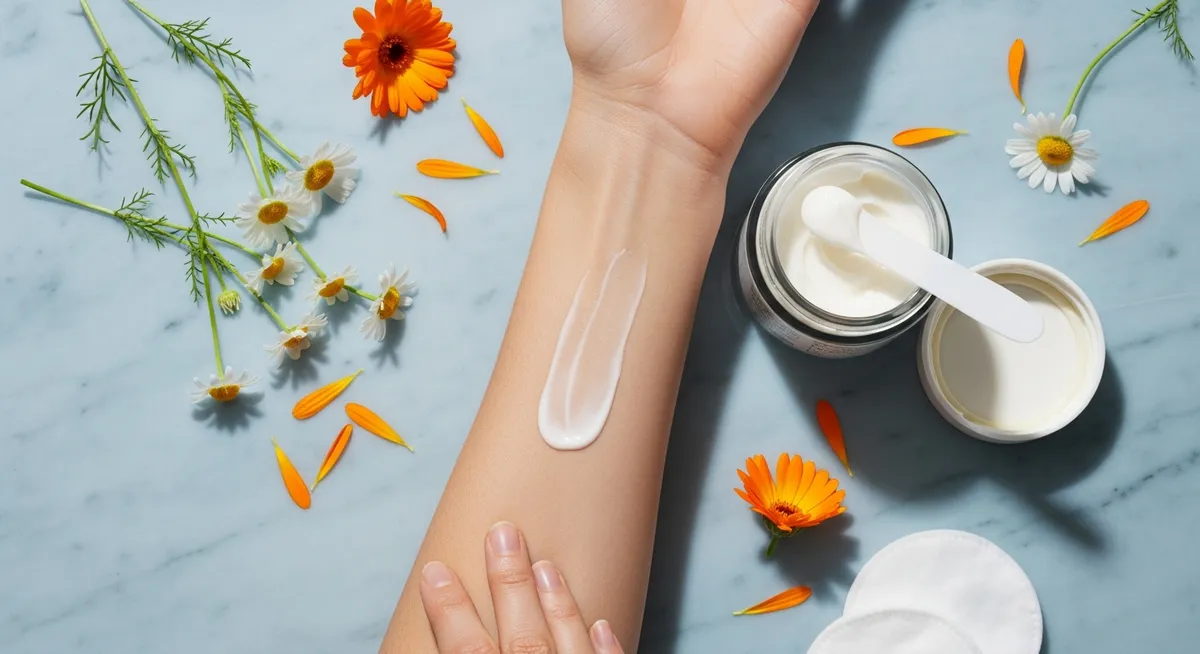
- Test properly. Dermatologists who run repeated open application tests most often apply a product twice daily to the forearm for one to two weeks, and no standard method has been established (Brown et al., Dermatitis, 2015). The original 1986 protocol was seven days on the inner forearm, stopping if a rash appeared (Hannuksela and Salo, 1986). Our patch test guide describes it, and anyone with known contact allergy should ask an allergist or dermatologist about proper clinic patch testing.
- One change at a time, after the AAD basics are in place.
- Stop and call at any new redness, itching or rash.
Who should skip it
If you react to ragweed, chamomile or other daisy-family plants, or have a known Compositae allergy, the safest answer is to skip it and ask an allergist. For children, the EU monograph does not recommend skin use under age 6 because data are lacking, so for a baby's eczema the call is a pediatrician, and our children's eczema article goes further. Pregnancy and breastfeeding: safety is not established and the monograph recommends against use, so ask your OB/GYN or midwife. Severe, infected, or widespread eczema belongs with a dermatologist, not a bottle. See also calendula and ragweed allergy and can calendula oil replace prescription medications.
What we can tell you about the oil
We buy dried Calendula officinalis flowers, organically grown on family farms, and make the oil in-house: calendula is extracted on its own, then brought into a carrier oil, which the site does not name (ask us for it on the batch paperwork). We add no preservatives, tocopherol or stabilizers. Every batch is tested by independent third-party labs, bottles are dated and lot-numbered, and you can email the lot number to [email protected] for the batch documentation. Our own stated limits: no medical claims, patch test first, skip it if you react.
Calendula Oil
Nature's Golden Botanical, bottled: small-batch calendula oil in sizes from 0.5 oz to bulk.
From $13.99
Shop Calendula Oil →Sources & Further Reading
- Jensen MB et al., 2026. Association between atopic dermatitis and contact sensitization: an updated systematic review and meta-analysis. Contact Dermatitis 94(3):201-225. pubmed.ncbi.nlm.nih.gov/41423749
- European Medicines Agency, HMPC, 2018. European Union herbal monograph on Calendula officinalis L., flos (EMA/HMPC/437450/2017). ema.europa.eu
- European Medicines Agency, HMPC, 2018. Assessment report on Calendula officinalis L., flos (EMA/HMPC/603409/2017). ema.europa.eu
- Reider N et al., 2001. The seamy side of natural medicines: contact sensitization to arnica and marigold. Contact Dermatitis 45(5):269-272. pubmed.ncbi.nlm.nih.gov/11722485
- Paulsen E, 2002. Contact sensitization from Compositae-containing herbal remedies and cosmetics. Contact Dermatitis 47(4):189-198. pubmed.ncbi.nlm.nih.gov/12492516
- Paulsen E, Christensen LP, Andersen KE, 2008. Cosmetics and herbal remedies with Compositae plant extracts: are they tolerated by Compositae-allergic patients? Contact Dermatitis 58(1):15-23. pubmed.ncbi.nlm.nih.gov/18154553
- American Academy of Dermatology. Atopic dermatitis: self-care. aad.org, atopic dermatitis self-care page
- American Academy of Dermatology. How to reduce eczema flares with moisturizer. aad.org, moisturizer page
- Gómez-Farto A et al., 2024. Development of an emulgel for atopic dermatitis: biocompatibility and clinical investigation. Gels 10(6):370. pubmed.ncbi.nlm.nih.gov/38920917
- Gómez-Farto A et al., 2025. Update on the research of an emulgel for atopic dermatitis: clinical investigation in children. Gels 11(11):880. pubmed.ncbi.nlm.nih.gov/41294565
- Crnčević MŠ et al., 2025. Double-blind randomised controlled trial of an emollient cream with and without 1% supercritical CO2 extract of Calendula officinalis in contact dermatitis. Acta Pharm 75(4):699-708. pubmed.ncbi.nlm.nih.gov/41527980
- Kloter E et al., 2023. Phytotherapy in paediatric skin disorders: a systematic literature review. Complement Ther Med 74:102942. pubmed.ncbi.nlm.nih.gov/36958415
- U.S. Food and Drug Administration. Is it a cosmetic, a drug, or both? fda.gov, cosmetic or drug page
- U.S. Food and Drug Administration, 2017. Warning letter to Be Natural Organics (MARCS-CMS 523615). fda.gov, warning letter 523615
- Brown GE et al., 2015. Clinical utilization of repeated open application test among American Contact Dermatitis Society members. Dermatitis 26(5):224-229. pubmed.ncbi.nlm.nih.gov/26367205
- Hannuksela M, Salo H, 1986. The repeated open application test (ROAT). Contact Dermatitis 14(4):221-227. pubmed.ncbi.nlm.nih.gov/2941220