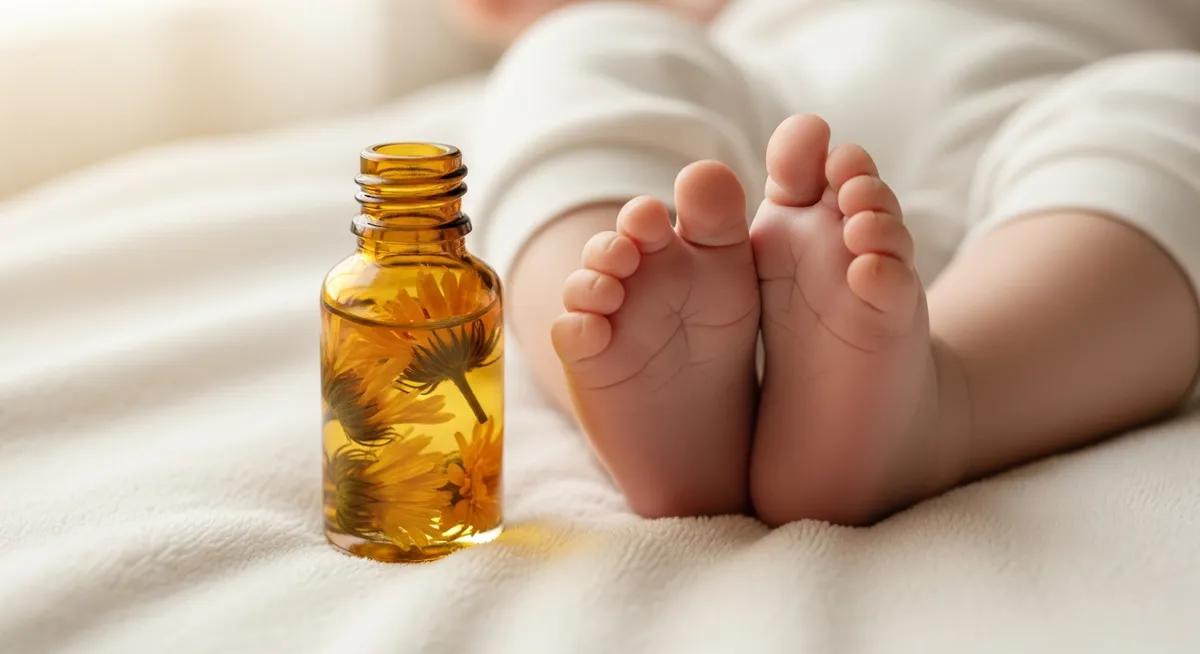
Calendula Oil and Babies: What to Ask Before You Use It
We do not sell our calendula oil as a baby product, and we will not call it baby safe, because no source we can cite supports that phrase for any calendula oil. The EU herbal committee says use of calendula skin preparations in children under 6 has not been established for lack of data. The American Academy of Pediatrics says natural therapies are not safe just because they are natural. What follows is what the published evidence on infants does show, mainly diaper rash trials of ointments, and the questions to take to your pediatrician before putting any botanical oil on a baby.

Calendula Oil
Our own small-batch calendula oil, in sizes from 0.5 oz to bulk.
From $13.99
Shop Calendula Oil →The three statements that frame the decision
- The EMA's 2018 monograph says skin use in children under 6 is not recommended and "has not been established due to lack of adequate data." That reflects missing data, not documented harm, and it applies to licensed herbal medicines.
- The AAP's HealthyChildren.org page on natural therapies (last updated 2015) says therapies are not safe just because they are natural, notes the FDA does not guarantee purity, potency, effectiveness or safety of natural products sold as supplements, and advises checking with your child's doctor before adding or changing a therapy. It does not mention calendula.
- Calendula is in the Asteraceae (daisy) family, and the EMA lists hypersensitivity to that family as a contraindication. Skin sensitization has been reported, frequency unknown.
What the diaper rash trials show
This is the only place infant skin trials of calendula exist in the sources we reviewed. Read the three together, because they point different ways:
| Trial | Who and what | Result as reported | Limit |
|---|---|---|---|
| Panahi et al., 2012 | 66 infants under 3; calendula ointment (1.5% extract) vs aloe vera cream, 3 times daily for 10 days | Both groups improved; fewer rash sites in the calendula group (P=0.001) | No placebo or untreated group; the EMA called the extract not well defined |
| Mahmoudi et al., 2015 | 100 infants; bentonite cream vs calendula cream | Complete improvement within 3 days in 86% (bentonite) vs 52% (calendula), P<0.001 | Calendula was the comparator; concentration not stated; 3-day follow-up |
| Sharifi-Heris et al., 2018 | 73 children under 2; 1.5% olive ointment vs 1.5% calendula ointment | No significant difference in severity on days 3, 5 and 7 | No untreated arm, so equal scores do not show either works |
What to take from this: calendula did better than aloe, worse than a clay cream, and the same as olive ointment. None of the trials had a placebo or no-treatment arm, and diaper rash often resolves by itself, so improvement in a group is not proof the ointment caused it. Reasoning from the olive result, the ointment base may be doing a good share of the work, since a plain olive ointment performed no differently. That is an inference from a non-significant difference, not a finding. Importantly, all three tested ointments or creams. None tested an infused oil, which is what we make.
What baby product ingredient lists show
We have not tested any of the following products and describe only what each brand's own page says. Weleda's calendula baby oil lists sesame and sweet almond oils with calendula and chamomile flower extracts, fragrance and several named fragrance components, and carries the NATRUE certified natural logo. Its calendula diaper cream states 12% zinc oxide. Burt's Bees Baby diaper rash ointment lists zinc oxide 40% as its active ingredient, with calendula flower extract among many minor inactive ingredients.
Reasoning from those lists, a calendula oil by itself is not the same kind of product as a diaper cream, whose active component in these examples is zinc oxide. If a parent is shopping for diaper rash, the label question to ask is what the product's active ingredient is, not whether the word calendula appears on it. For our take on the rash question specifically, see the diaper rash guide.
Why an infant is a different question from an adult
We found no calendula-specific infant safety data beyond those trials, so this section is reasoning. Infant skin is a smaller surface with less history of use, and a reaction is harder to read when the child cannot tell you what it feels like. The National Association for Holistic Aromatherapy says infants, toddlers and young children are more sensitive and suggests much lower essential-oil dilutions for them. That guidance concerns essential oils, not infused oils, but it is a reason never to add essential oils to a calendula oil for a baby. Ours has none added, and nothing else either: no preservatives, tocopherol or stabilizers.
Carrier oil is the other variable. Our oil is a calendula-only extract brought into a carrier oil, and the carrier is on the batch paperwork: email the lot number from the bottle to [email protected]. The EMA assessment notes peanut oil is not recommended as a calendula carrier because of a higher probability of adverse reactions, which shows carrier choice is a safety question in its own right. If your baby has a diagnosed food or skin allergy, the pediatrician or allergist should see that carrier name.
What to ask your pediatrician
- Is there any reason my baby's skin should not have a plant-oil product on it, given their age and any eczema or allergy history?
- For this particular problem (dry skin, diaper rash, cradle cap), is there a product you already prefer?
- Here is the carrier oil and the ingredient list. Is anything on it a concern?
- If we try it, where and how often, and what should make us stop?
- Would you do a patch test, or advise a small trial area first?
If the answer is no, that settles it. If the answer is a yes with conditions, follow the conditions rather than anything on a website, including ours. A rash that is raw, blistering, weeping or accompanied by fever needs the pediatrician, not an oil, and for a baby with eczema, our page on children's eczema covers the evidence.
Where we land
We make the oil from organically grown flowers, document each batch and can name what is in it. We cannot tell you it is right for a baby, and the EU herbal regulator says the data to say so do not exist. For related questions, see the quick FAQ on babies, how calendula oil compares with coconut oil for baby skin, and the allergy FAQ.
Calendula Oil
Nature's Golden Botanical, bottled: small-batch calendula oil in sizes from 0.5 oz to bulk.
From $13.99
Shop Calendula Oil →Sources & Further Reading
- EMA/HMPC, 2018. European Union herbal monograph on Calendula officinalis L., flos. ema.europa.eu/EMA/HMPC/437450/2017
- EMA/HMPC, 2018. Assessment report on Calendula officinalis L., flos. ema.europa.eu/EMA/HMPC/603409/2017
- American Academy of Pediatrics, 2015. Natural therapies and children: FAQs. healthychildren.org/Natural-Therapies
- Panahi et al., 2012. Aloe vera and Calendula officinalis on diaper dermatitis in children. ScientificWorldJournal. pubmed/22606064
- Mahmoudi et al., 2015. Bentonite and calendula on infantile diaper dermatitis. Indian J Med Res. pubmed/26831423
- Sharifi-Heris et al., 2018. Olive and calendula ointments on children's diaper dermatitis. Dermatol Ther. pubmed/30311724
- Weleda US. Comforting baby oil, calendula; Calendula diaper cream (brand product pages, accessed 2026). weleda.com/baby-oil-calendula
- Burt's Bees Baby. Bee Natural diaper rash ointment (brand product page, accessed 2026). burtsbeesbaby.com/diaper-rash-ointment
- National Association for Holistic Aromatherapy. Safety. naha.org/safety