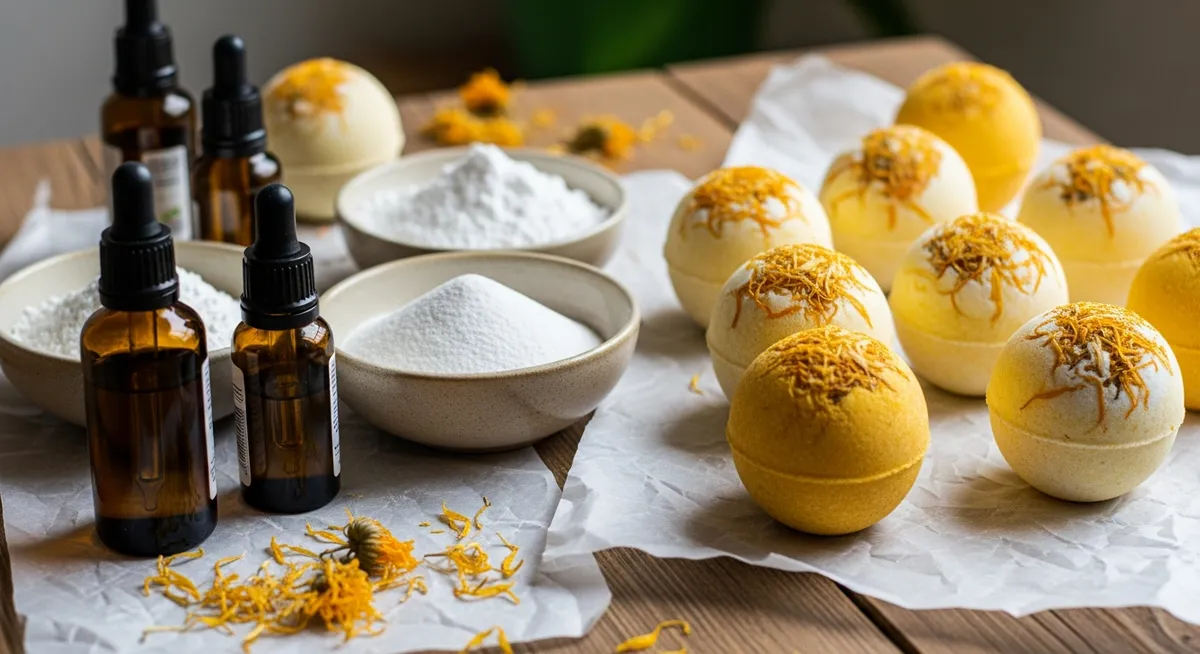
Calendula Oil in the Bath: Bath Bombs vs Simpler Options
A bath bomb is the wrong vehicle for sensitive skin, and adding calendula oil does not change that. The parts of a bath bomb most likely to cause trouble are the fragrance, the dye and the long soak, not the calendula, and the oil we make would be a small addition to a product built around fizz. We have not tested a bath bomb recipe with our oil, and we are not publishing gram ratios we could not source, so this is a decision guide, not a recipe.

Calendula Oil
Our own small-batch calendula oil, in sizes from 0.5 oz to bulk.
From $13.99
Shop Calendula Oil →What a bath bomb actually is
A bath bomb is a compacted mix of a weak acid and a bicarbonate base that do not react while dry. In water, citric acid and sodium bicarbonate form monosodium citrate, water and carbon dioxide, which is the fizz, and most bombs also contain scent and dye, with lathering agents such as sodium lauryl sulfate in some. According to the Wikipedia article on bath bombs (a tertiary source, so treat it as a pointer), fragrances and dyes can irritate skin, with limonene, linalool and sodium lauryl sulfate named as common irritants or allergens, while citric acid and bicarbonate are generally not considered irritants at bath dilution. In other words, the fizz is not the problem. Everything added to make the bomb colorful and scented is.
What a dermatologist says
Dr. Alok Vij, a dermatologist at the Cleveland Clinic, said that "There aren't any bath bombs that are totally safe, particularly for people with sensitive skin" (Cleveland Clinic Health Essentials). He added that size does not matter, because small bombs can hold concentrated allergens, and that natural ingredients "can also play mischief with your skin." The article names fragrances, whether synthetic or from essential oils, and dyes, whether natural or lab-made, as possible irritants, and glitter as potentially abrasive. For people without eczema or known fragrance sensitivity, "the occasional bath bomb is fine," and he advises staying in only until fingers and toes begin to prune, usually 10 to 15 minutes, then rinsing off. He said people who are allergic to bath bomb ingredients should avoid them altogether, and framed occasional use as fine for those without eczema or a known sensitivity to fragrances or dyes.
That is one clinician's published advice, not a trial. We cite it because it matches the way the problem is built: more ingredients means more chances to react, and "sensitive skin" is the group least able to absorb the experiment.
The bath itself matters more than the additive
The American Academy of Dermatology's guidance for nummular eczema says to take baths and showers that last no longer than 20 minutes, to avoid fragrance because "even when you cannot smell the fragrance, it can irritate your skin," and to apply a fragrance-free moisturizer to damp skin after every bath, specifying a cream or ointment rather than a lotion. Its psoriasis bathing guidance says to limit baths to 15 minutes or less, to use warm, not hot, water, and to apply a fragrance-free moisturizer within five minutes of getting out. These are conditions with their own advice, but the pattern is consistent: short, warm, unscented, then moisturize. A scented fizzing soak with a dye is the opposite pattern.
Where calendula oil fits instead
We would not put calendula oil in the water at all. Reasoning from basic chemistry, oil and water separate, so most of the oil floats on the surface and coats the tub, and we know of no study that measured how much of a calendula oil reaches skin from bath water. The AAD advice above is to moisturize damp skin after the bath, but it names a fragrance-free cream or ointment, and an oil is a different product from both. So if you have eczema, ask a dermatologist before using any oil. For skin without a diagnosed condition, a small amount of oil on still-damp skin after a short, warm bath is the use we can explain; it is our reasoning and not a tested routine.
The oil we make is an infusion: dried flowers, extracted for calendula alone, then brought into a carrier oil, with nothing else added. The carrier is not named on the website; it is on the batch paperwork, and you can email the lot number to [email protected] before you use it on a skin condition. Our daily routine guide covers where an oil sits in a routine.
It is also worth knowing what the traditional water form of calendula looks like. The EU monograph lists a warm infusion of 1-2 g of flowers in 150 ml of water, used to prepare impregnated dressings that are removed after 30-60 minutes (EMA/HMPC, 2018). That is a licensed-medicine framework for small areas, not a bath, and nothing in the sources we reviewed tests calendula in a full tub, so we do not extrapolate it.
If you make a bath bomb anyway
We would change the ingredient list before we thought about the oil.
- Leave out the fragrance, the essential oils and the dye. Those are the ingredients the sources above identify, and "natural" versions are in the same category.
- Leave out glitter, and witch hazel as a binder: the Cleveland Clinic article cites witch hazel as an astringent that can cause dryness, and cocoa butter as something that can encourage yeast growth.
- Keep the base simple: sodium bicarbonate, citric acid, a binder and a modest amount of oil. We could not source a tested gram ratio for that, so use a published base from a soap-supply educator and swap in a calendula oil you already tolerate.
- Test the finished product on a small patch of skin before the whole body goes in, and keep the soak short.
The pH of a bath bomb in water is not something we found data on, so we cannot say how it compares with skin's range of about 4.1-5.8 (Proksch, 2018). If you have vulvar or urinary symptoms after bathing, that belongs with a clinician, not with a recipe.
Who should skip calendula in the bath
Calendula is a daisy-family plant. The EU monograph lists hypersensitivity to Asteraceae plants as a contraindication, notes skin sensitization has been reported, and does not recommend use under 6 years or during pregnancy and lactation because data are lacking (EMA/HMPC, 2018). In one Austrian patch-test series, 9 of 443 dermatitis patients (about 2%) reacted to marigold (Reider et al., 2001), a clinic group rather than the general population. If you react to chamomile, chrysanthemum or ragweed products, read our allergy guide first. After any bath product, FDA advises stopping a cosmetic that causes a rash or burn and contacting a healthcare provider. A child's rash after a bath belongs with a pediatrician.
Our view is plain. If your skin is sensitive, skip the bomb, keep the bath short and warm, and use the oil, if at all, afterward. See the shop for the oil itself.
Calendula Oil
Nature's Golden Botanical, bottled: small-batch calendula oil in sizes from 0.5 oz to bulk.
From $13.99
Shop Calendula Oil →Sources & Further Reading
- Wikipedia. Bath bomb (tertiary source). wikipedia.org/Bath_bomb
- Cleveland Clinic Health Essentials. Is marinating in the tub with a bath bomb safe for your skin? health.clevelandclinic.org/bath-bomb
- AAD, undated. Nummular eczema self-care. aad.org/diseases/eczema/tips
- AAD, undated. 8 ways to stop baths and showers from worsening your psoriasis. aad.org/psoriasis/baths-showers
- Proksch E, 2018. pH in nature, humans and skin. J Dermatol 45(9). pubmed/29863755
- EMA/HMPC, 2018. EU herbal monograph on Calendula officinalis L., flos. ema.europa.eu/monograph
- Reider N et al., 2001. Contact sensitization to arnica and marigold. Contact Dermatitis 45(5). pubmed/11722485
- FDA. Using cosmetics safely. fda.gov/using-cosmetics-safely