
Calendula Toners and Mists: What Is Actually in the Bottle
A calendula toner and a calendula oil share a plant and very little else. A toner is a water product, so whatever calendula it contains was carried in water or a water-based solvent, while the oil we make is an infusion into a carrier oil. We have not tested any toner or mist on the market and we do not make one, so this is not a ranking. It is what we would check on a label, and what we would say if you asked whether calendula in a mist is worth paying for.
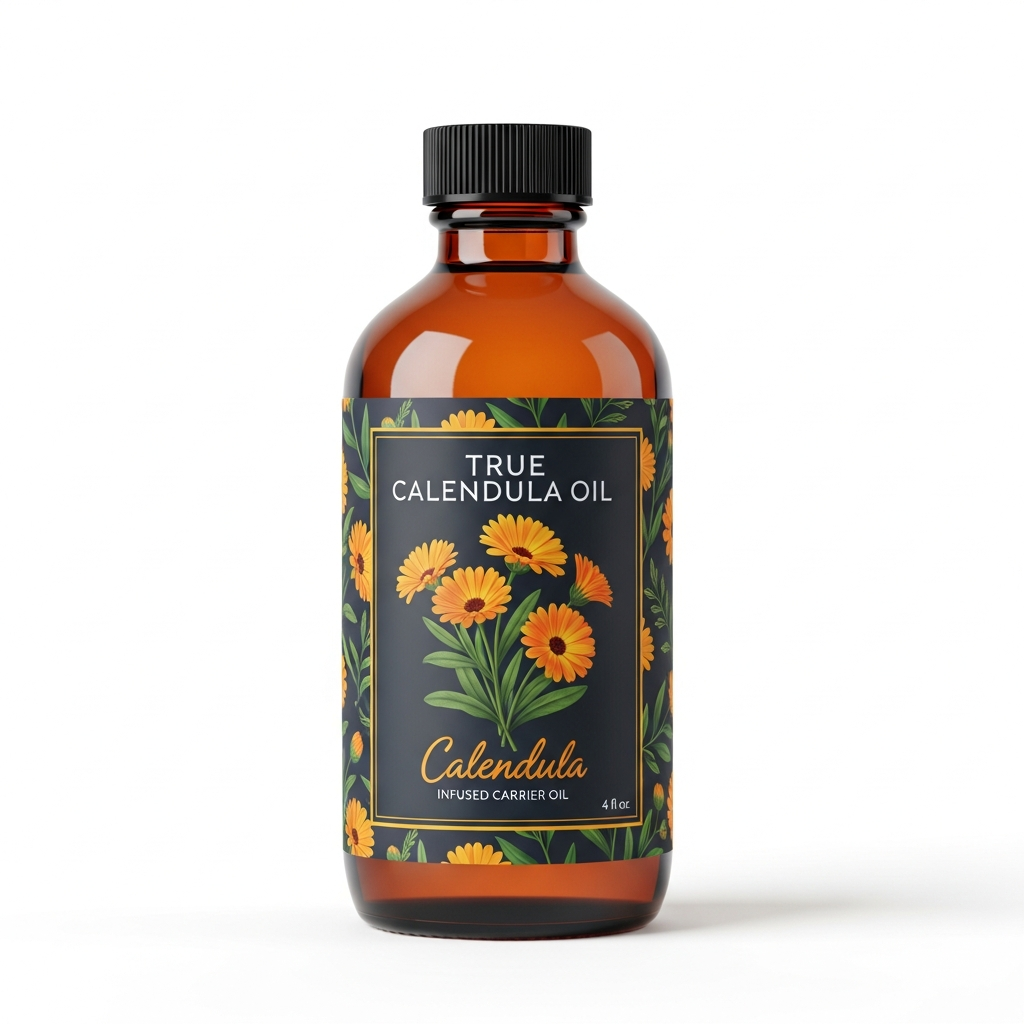
Calendula Oil
Our own small-batch calendula oil, in sizes from 0.5 oz to bulk.
From $13.99
Shop Calendula Oil →Water and oil pull different things out of the flower
Calendula flowers contain water-soluble and oil-soluble material. The water-soluble side includes the oleanolic-acid saponins, which the EU assessment report (2008) puts at 2-10% of the dried herb (saponins of this type are glycosides, which dissolve in water, our reasoning), and the polysaccharide fractions that 1980s laboratory work isolated from water and alkali extracts (Olennikov and Kashchenko, Molecules, 2022). The oil-soluble side includes the carotenoids behind the orange color and the faradiol esters, which a 2025 study found in the flower heads, with about 12-13 mg/g dry weight each of the myristate and palmitate in the ray petals of one cultivar (Golubova et al., Nature Communications, 2025).
Reasoning from that split, the practical consequence is that a water-based toner and an infused oil are not two versions of one thing. A toner would carry the polar compounds and little of the pigments and esters; an oil does the reverse. No study we found measured these compounds in a finished toner or in an infused oil, so treat that as reasoning from solubility, not a measured comparison. It still changes the question you should ask. "Does it contain calendula?" tells you almost nothing. "Calendula extracted how, and how much of it?" tells you more.
What to read on the label
- Position in the ingredient list. FDA says cosmetic ingredients must generally be listed in descending order of predominance (FDA, Cosmetic Ingredient Names). In a toner, "Aqua" is usually first. If calendula extract sits below the preservative and the fragrance, there is very little of it.
- The name tells you the source, not the amount. The Cosmetic Ingredient Review lists calendula flower extract at up to 6% in cosmetic use (CIR quick reference, 2017). That is a ceiling for what the panel reviewed, not what a given toner contains.
- Fragrance. The American Academy of Dermatology warns that "even when you cannot smell the fragrance, it can irritate your skin" (AAD, nummular eczema self-care). The page concerns eczema, so reasoning from it, a scented mist is a likelier source of a reaction than the calendula in it.
- Preservation. A product that is mostly water needs preservation: a 2018 review says cosmetics that contain water require preservation against microbial contamination, verified by methods such as the challenge test (Halla et al.), and an FDA inspection manual flags products labeled "natural" or "no preservatives" for microbiological sampling when preservation adequacy is in doubt (FDA Compliance Program 7329.001, 2016). A "preservative-free" mist is not a feature.
- Claims. FDA does not define "hypoallergenic" or "natural" for cosmetics (FDA, Using Cosmetics Safely). "For sensitive skin" is not a tested category.
What the evidence says about hydration
The human studies are on creams, not toners. In a 2025 double-blind trial of 20 healthy volunteers with chemically irritated forearm skin, hydration was higher at sites with an emollient cream containing 1% calendula CO2 extract than at placebo-cream or untreated sites on day 4, with no significant difference in redness (Crnčević et al., Acta Pharm). In an 8-week study of 21 healthy volunteers, two of seven skin-mechanics measures differed between a calendula-extract cream and a base cream (Akhtar et al., Acta Pol Pharm, 2011). Both are small. Reasoning from the format, a mist is on the skin for far less time than a cream, so a cream trial is weak support for a toner. The EU herbal committee concluded the clinical evidence was not sufficient for a well-established use (EMA, 2018). So "hydrating calendula toner" is a hope about a formula, not something a trial has shown for toners.
Skin pH is the better question
A 330-person study estimated natural skin surface pH at about 4.7 and found that soap and tap water raise it temporarily, with tap water raising it for up to 6 hours (Lambers et al., 2006). A review gives the normal pH of the outer skin layer as 4.1-5.8 (Proksch, 2018). Reasoning from those figures, the pH of a leave-on water product is more likely to matter to your skin than the calendula in it. Most toner labels do not print a pH, and we cannot tell you the pH of anyone's product. If a brand does not publish it, ask.
Where our oil fits, and where it does not
Our oil does not belong in a toner. Oil and water do not mix, and a water-based product with oil in it is an emulsion or a shaken mixture that needs its own preservation. When we make the oil we extract calendula alone and then bring the extract into a carrier oil, with nothing else added, which is a different material from the calendula water in a toner. For the one place the two can meet, the AAD's eczema guidance says to apply a moisturizer to damp skin after bathing, and specifies a fragrance-free cream or ointment rather than a lotion. An oil is a different product from either, so for eczema ask a dermatologist. For normal skin, a few drops of oil on still-damp skin after a mist is the version of the idea we can explain, but it is our reasoning and not a tested routine. Our facial mist article explains why we do not give a water-and-oil recipe, and the daily routine guide and face questions guide cover oil use. The carrier in our oil is not named on the site; the batch paperwork lists it (email the lot number to [email protected]).
Who should skip calendula toners
Calendula is in the daisy family (Asteraceae). The EU monograph lists hypersensitivity to Asteraceae plants as a contraindication and notes skin sensitization has been reported (EMA/HMPC, 2018), and in one Austrian clinic series 9 of 443 dermatitis patients (about 2%) reacted to marigold (Reider et al., 2001). Those were patients referred for dermatitis, so the number does not describe everyone. A mist goes on the whole face, near the eyes, and the CIR assessment notes calendula ingredients may be mild ocular irritants (Andersen et al., 2010), so close your eyes and keep it out of them. Test on a small patch first and see our allergy guide if you react to chamomile, chrysanthemum or ragweed.
If you want a calendula toner, buy one on the strength of its full ingredient list, its preservation and its fragrance, not on the flower. If you want our oil, it is an oil, and by our reasoning it belongs at the end of a routine, after the water-based steps. See the shop if that is what you are looking for.
Calendula Oil
Nature's Golden Botanical, bottled: small-batch calendula oil in sizes from 0.5 oz to bulk.
From $13.99
Shop Calendula Oil →Sources & Further Reading
- Olennikov DN, Kashchenko NI, 2022. Marigold metabolites. Molecules 27(23):8626. europepmc/PMC9736270
- EMA/HMPC, 2008. Assessment report on Calendula officinalis L., flos (superseded). ema.europa.eu/assessment-report-2008
- Golubova D et al., 2025. Biosynthesis and bioactivity of anti-inflammatory triterpenoids in Calendula officinalis. Nat Commun. pmc/PMC12304140
- FDA. Cosmetic ingredient names. fda.gov/cosmetic-ingredient-names
- FDA. Using cosmetics safely. fda.gov/using-cosmetics-safely
- FDA, 2016. Compliance Program Guidance Manual 7329.001, Cosmetics program. fda.gov/media/78441
- Cosmetic Ingredient Review, 2017. Quick reference table, review conclusions. cir-safety.org/S-092016
- Andersen FA et al., 2010. Amended safety assessment of Calendula officinalis-derived cosmetic ingredients. Int J Toxicol 29(6 Suppl). pubmed/21164072
- AAD, undated. Nummular eczema self-care. aad.org/diseases/eczema/tips
- Halla N et al., 2018. Cosmetics preservation: a review on present strategies. Molecules 23(7):1571. pubmed/29958439
- Crnčević MŠ et al., 2025. Emollient cream with and without 1% supercritical CO2 calendula extract in contact dermatitis. Acta Pharm 75(4). pubmed/41527980
- Akhtar N et al., 2011. Calendula extract: effects on mechanical parameters of human skin. Acta Pol Pharm 68(5). pubmed/21928714
- EMA/HMPC, 2018. Assessment report on Calendula officinalis L., flos (EMA/HMPC/603409/2017). ema.europa.eu/assessment-report
- EMA/HMPC, 2018. EU herbal monograph on Calendula officinalis L., flos. ema.europa.eu/monograph
- Lambers H et al., 2006. Natural skin surface pH is on average below 5. Int J Cosmet Sci 28(5). pubmed/18489300
- Proksch E, 2018. pH in nature, humans and skin. J Dermatol 45(9). pubmed/29863755
- Reider N et al., 2001. Contact sensitization to arnica and marigold. Contact Dermatitis 45(5). pubmed/11722485