
Calendula Eye Creams: What a Label Can and Cannot Tell You
We make a calendula oil, not an eye cream, and we are not going to rank other people's eye creams, because we have not tested any of them and no published study shows that calendula changes under-eye puffiness. What we can do is show you how to read a calendula eye cream label, which three or four details separate a careful product from a marketing one, and why the eye area deserves stricter rules than the rest of your face.
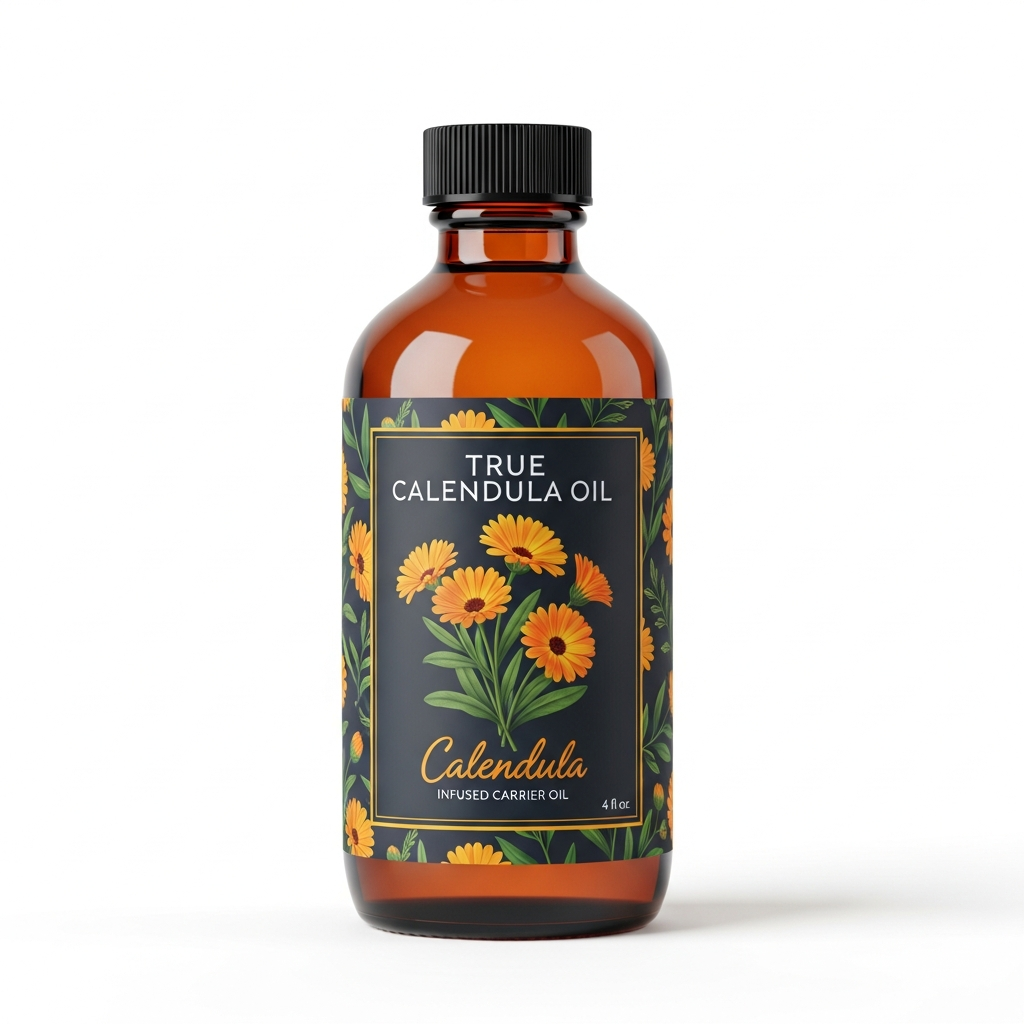
Calendula Oil
Our own small-batch calendula oil, in sizes from 0.5 oz to bulk.
From $13.99
Shop Calendula Oil →Why the eye area changes the rules
DermNet's page on eyelid contact dermatitis says eyelid skin is thin and reacts easily to irritants and allergens, so a trigger that causes no rash elsewhere can still inflame the lids. It lists eye creams, makeup, sunscreens, moisturisers and cleansers among the sources of allergic reactions, notes that fragrances and essential oils are allergens that can reach the lids from the fingers, and names Compositae allergy as one example of an airborne cause (DermNet, Eyelid contact dermatitis). Calendula is a Compositae (daisy family) plant, which is the point where the two facts meet: the EU herbal monograph lists hypersensitivity to Asteraceae plants as a contraindication and notes skin sensitization has been reported at an unknown frequency (EMA/HMPC, 2018).
Regulators also treat eye products as higher stakes. FDA's MoCRA guidance carves out an exemption from facility registration and product listing for small cosmetic businesses, but not for makers of products that regularly contact the mucous membrane of the eye (FDA, registration and listing guidance, 2024). And the Cosmetic Ingredient Review panel concluded in 2010 that calendula-derived ingredients are safe in cosmetics at the practices and concentrations it reviewed, while noting they "may be mild ocular irritants" (Andersen et al., Int J Toxicol, 2010). Take that last phrase literally: it is the safety panel's own wording about eyes.
What the evidence says about calendula and puffy eyes
Nothing, so far as we could find. A search of PubMed for calendula alongside dark circles, periorbital changes and related terms turned up no human trial, and the library of calendula skin studies we drew on contains none on under-eye puffiness. The trials that exist are on other things (radiation skin reactions, wounds, diaper rash), mostly with ointments or creams and often combination products, and the EU regulator judged most of the skin studies small and methodologically weak (EMA/HMPC, 2018). So any eye-cream copy that implies calendula reduces puffiness is borrowing from somewhere else. Puffy or tired-looking eyes have more than one possible cause, and persistent or one-sided swelling, or swelling with pain, vision change or a rash, is a reason to see a doctor or eye specialist rather than to shop.
Reading the label
1. Where is the calendula, and in what form?
US rules require ingredients in descending order of predominance, except that ingredients at 1% or less may be listed in any order after those above 1% (21 CFR 701.3, 1996 CFR). A calendula entry deep in the list could therefore be a trace, though the rule cannot prove that it is. For scale, the Cosmetic Ingredient Review's reference table lists calendula flower extract in cosmetics at 1 up to 6% (CIR Quick Reference Table, 2017). Also watch the name: an infused oil usually appears as the carrier plus "Calendula Officinalis Flower Extract," as in one commercial macerate's data sheet (Golgemma/Biolandes, FB026, 2025), and the name does not tell you how much is there.
2. What else is in it that touches the eye?
For allergy purposes the long tail of an eye cream matters more than the calendula. DermNet lists fragrances and essential oils among eyelid allergens. The AAD advises fragrance-free over "unscented," since unscented products can contain masked fragrance (AAD news release on eczema skin care at home, 2022). A calendula cream with a fragranced base is two allergy questions, not one.
3. How is it preserved?
A cream is water and oil together, and water changes the microbial picture. A 1995 review says the products that most need preservatives are those containing water (Brannan, J Soc Cosmet Chem, 1995). An FDA inspection manual directs sampling of eye-area cosmetics for microbes when challenge-test documentation cannot be produced or preservation is in doubt (FDA Compliance Program 7329.001, 2016). So "no preservatives" on a water-containing eye cream is a question, not a selling point. We will not call any specific brand's preservation good or bad, because we have not tested them.
4. Who can you reach?
FDA's guidance says each cosmetic must carry a domestic address, phone number or electronic contact through which the responsible person can receive adverse-event reports (FDA, 2024). If an eye product has none, that is a reason not to buy it.
Should our oil go near your eyes?
We would say no, and here is the reasoning. Our oil is calendula extract in a carrier, with no preservative, tocopherol or stabilizer added. It is sold as a cosmetic oil, not as an eye product, and we have no ophthalmic or periorbital testing to cite. Given the CIR panel's "may be mild ocular irritants" and the thinness of eyelid skin, we would keep it away from the lash line and the eye itself. If you want to use any oil on the skin below the eye, patch test first, and if you are unsure, ask a dermatologist or ophthalmologist. A patch test on the inner arm daily for 7 to 10 days is the AAD's suggested routine (AAD, 2022), and we explain it in our patch-test guide.
If you came for a do-it-yourself route, note that a homemade eye cream means water, a preservative you cannot challenge-test at home, and a product that sits next to the eye. We make the case in more detail in our guide to home projects and cover the under-eye question in calendula oil for under-eye dark circles.
Who should skip calendula near the eyes entirely
Anyone allergic to daisy-family plants, anyone with active eyelid dermatitis (DermNet advises seeing a dermatologist, with patch tests to find the trigger), and anyone pregnant or breastfeeding without clearance from an OB/GYN or midwife, since the EU monograph says safety in pregnancy and breastfeeding has not been established (EMA/HMPC, 2018). Contact lens wearers and people with eye conditions should ask their eye doctor.
What we would say to a friend: read the label for fragrance and preservation first, treat calendula as the least important line on it, and take puffiness that will not settle to a professional.
Calendula Oil
Nature's Golden Botanical, bottled: small-batch calendula oil in sizes from 0.5 oz to bulk.
From $13.99
Shop Calendula Oil →Sources & Further Reading
- DermNet. Eyelid contact dermatitis. dermnetnz.org
- European Medicines Agency, HMPC, 2018. EU herbal monograph on Calendula officinalis L., flos (EMA/HMPC/437450/2017). ema.europa.eu
- European Medicines Agency, HMPC, 2018. Assessment report on Calendula officinalis L., flos (EMA/HMPC/603409/2017). ema.europa.eu
- FDA, 2024. Guidance for industry: registration and listing of cosmetic product facilities and products. fda.gov/media/170732
- Andersen FA et al., 2010. Final report of the Cosmetic Ingredient Review Expert Panel amended safety assessment of Calendula officinalis-derived cosmetic ingredients. Int J Toxicol 29(6 Suppl):221S-243S. PMID 21164072
- 21 CFR 701.3, Designation of ingredients (1996 annual edition). govinfo.gov
- Cosmetic Ingredient Review, 2017. Quick reference table: review conclusion. cir-safety.org
- Golgemma/Biolandes, 2025. Technical data sheet, Calendula Org Macerate/Oil FB026. biolandes.com FB026
- American Academy of Dermatology, 2022. Eczema skin care at home (news release, 27 Oct 2022). aad.org
- Brannan DK, 1995. Cosmetic preservation. J Soc Cosmet Chem 46:199-220. library.scconline.org
- FDA, 2016. Compliance Program Guidance Manual 7329.001, Cosmetics program, chapter 29. fda.gov/media/78441