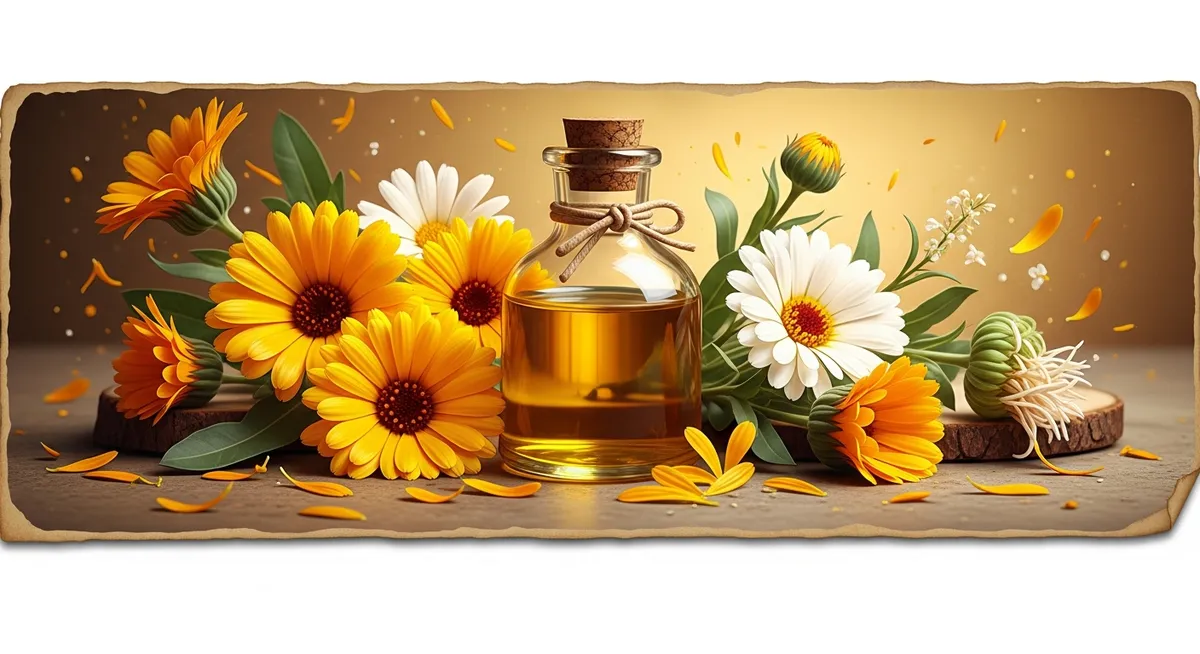
Calendula Oil: Surprising Facts and What It Can't Do
The most surprising thing about calendula oil is how much of what gets written about "calendula" describes a different product: the seed oil, the distilled essential oil, the CO2 extract, or a water-based extract used in a lab. We make an infused oil, which is flowers extracted into a carrier oil, so the useful question is which of the well-known facts apply to a bottle like ours. This article sorts the true, the true-but-about-something-else, and the unsupported. Some of it will read as a list of things calendula oil does not do, and we think that is the more useful list.

Calendula Oil
Our own small-batch calendula oil, in sizes from 0.5 oz to bulk.
From $13.99
Shop Calendula Oil →The orange is carotenoids, and it varies a lot by flower
In a four-variety study using HPLC, total carotenoids ranged from 48.2 mg per 100 g of fresh flowers in a yellow-orange variety to 276 mg per 100 g in a dark orange one, and a lemon-yellow variety was 97.0; the authors tie the yellow-to-orange colour mostly to carotenoids and the pigment mix differed by variety (Pintea et al., Acta Biologica Szegediensis, 2003). The pigments they identified include flavoxanthin, lutein and beta-carotene, among others, so "it is orange because of beta-carotene" is too simple. A 2022 review reports about a hundred carotenoids in the species and levels from trace amounts up to about 200 mg per 100 g of dry petals depending on variety (Olennikov and Kashchenko, Molecules, 2022). The consequence for buyers: oil colour on its own says little, because flower variety, drying and carrier all change it. We do not state carotenoid numbers for our oil in articles; the certificate on the shop page and the batch documentation, available on request by lot number, are where to look. Our carotenoid article goes further.
The petals hold the pigment, which is why we separate them
In one cultivar, petals held 103.8 mg of carotenoids per 100 g of fresh flower against 8 mg in the tubular centre florets (Pintea et al., 2003). A 2025 Nature Communications study found faradiol esters, the triterpene compounds most studied in calendula, only in floral tissue, with ray florets holding about eight times more than disc florets, about 12-13 mg per gram of dry weight each for the myristate and palmitate, and none in leaves or roots in the samples tested (Golubova et al., Nature Communications, 2025). Reasoning from that, hand-separating petals from sound, whole-dried flower heads is a sensible way to concentrate on the part of the flower where these compounds sit, and it is what we do. We do not claim our oil contains any particular amount of them; we have not published that analysis, and no source we found measured how much of either compound transfers into an infused oil.
The headline laboratory results were not done on oil
A frequently cited 1994 study found faradiol-type triterpenoids were the main active principles in a CO2 extract of calendula flowers tested on animals; unesterified faradiol was most active and the activity tracked faradiol monoester content (Della Loggia et al., Planta Medica, 1994). In 1997, isolated faradiol esters reduced croton-oil-induced ear swelling in mice (Zitterl-Eglseer et al., J Ethnopharmacol, 1997). Both used extracts or isolated compounds in animals, not infused oil on people. The water-soluble compounds, such as polysaccharides, saponins and flavonoid glycosides, were tested in water or alkali extracts. Reasoning from their chemistry, those would be expected in water or ethanol extracts rather than in an oil, but we found no measurement either way, so that is an inference. When an article says calendula "boosts immunity" from polysaccharides, it is describing a fraction an oil infusion is not known to contain.
Calendic acid belongs to the seed oil, not the petal oil
Calendula seed oil is unusual: in an 11-genotype study calendic acid made up 51.4-57.6% of its fatty acids (Dulf et al., Chemistry Central Journal, 2013). Solvent extracts of petals looked different: in a small study, oleic acid was about 42% and linoleic about 17% of fatty acids (Rafajlovska et al., 2012). Infused oil is flowers in a carrier. Even if everything hexane could pull out of dried petals (13.76% of dry weight in that study) transferred into a 1:10 mixture, that is about 1.4% of the mix by weight, and it would be oleic and linoleic type lipids, not calendic type. This is arithmetic, not a measurement: we found no published fatty acid analysis of an infused calendula oil, and a 2025 study found that herbal maceration can shift fatty acid proportions in some oils (Laskos et al., Scientific Reports, 2025), with basil and sage at heavy loads. The fair summary is that an infused oil's fatty acids are mostly the carrier's, so a "calendic acid" benefit claim for a petal-infused oil is unsupported. See also our calendic acid article.
"Marigold" on a supplement label is usually a different plant
The commercial source of "marigold extract" lutein is normally Tagetes (African or French marigold), a different genus from Calendula officinalis. A 2026 review table lists lutein by solvent extraction at 4-30 mg per 100 g for Calendula and 21.6-97.6 for Tagetes erecta (Kurniawan et al., Foods, 2026). The difference matters for safety too: ASPCA lists Calendula officinalis (pot marigold) as non-toxic to dogs and cats (ASPCA), while Pet Poison Helpline rates Tagetes mildly irritating to the gut and notes calendula is non-toxic when eaten (Pet Poison Helpline). These rate the plants, not oils; for a pet, ask a veterinarian.
"Calendula essential oil" is another product, and so is its SPF number
Distilling calendula flowers gives very little volatile oil: 0.2-0.3% of the herb in the EU assessment report (EMA/HMPC, 2008, superseded), 0.9 g per 100 g in one laboratory hydrodistillation (Salome-Abarca et al., 2015). That distillate is a different material from an orange infused oil. The SPF figures that circulate, 8.36, 14.84 and 18.54, come from in vitro spectrophotometer studies of distilled essential oil or creams made with it, with no human testing (Lohani et al., 2019; Mishra et al., 2012; Lohani et al., 2021). FDA regulates sunscreens as nonprescription drugs with SPF set by standardized testing (FDA, Sunscreen). Our oil is not a sunscreen; see our SPF article and the essential oil comparison.
What human studies actually showed
One result is genuinely modest and real. In a 2025 double-blind study of 20 healthy volunteers with chemically induced irritation, skin hydration was higher on forearm sites with a cream containing 1% calendula CO2 extract than on placebo-cream or untreated sites on day 4, with no significant difference in redness (Crncevic et al., Acta Pharm, 2025). That is a cream with a CO2 extract, in volunteers with induced irritation, not an infused oil. For radiation dermatitis, sources split: a 2004 trial of 254 women found grade 2 or higher dermatitis in 41% with calendula ointment and 63% with trolamine (Pommier et al., J Clin Oncol, 2004), while a blinded trial of 411 women found 23% versus 19% against a standard cream, no significant difference (Sharp et al., Eur J Oncol Nurs, 2013). The EU committee's summary is that calendula is accepted on traditional use because trial evidence is insufficient, and a 2025 periodic review of newer literature did not change it (EMA, public summary, 2018; EMA/HMPC addendum, 2025).
Four jobs it does not do
- Protect against the sun. No human SPF data; the lab numbers are for distilled oil.
- Preserve your recipe. Oil-phase antioxidants such as tocopherol slow oxidation; they do not stop microbes. Water-containing products need a real preservative system (Halla et al., Molecules, 2018). Nothing is added to our oil, so that is on the maker.
- Act as a calendic acid or polysaccharide supplement. See above.
- Take years off. In an 8-week study of 21 volunteers, two of seven skin-mechanics measurements differed between a calendula-extract cream and a base cream, and the study did not assess wrinkles (Akhtar et al., Acta Pol Pharm, 2011). We found no hair-growth study either.
Who should not use it
The EU monograph lists hypersensitivity to daisy-family (Asteraceae) plants as a contraindication, does not recommend skin use under 6, and says safety in pregnancy and breastfeeding has not been established (EMA/HMPC, 2018). Patch test first, and see a dermatologist for any skin condition.
If what you want is a plain calendula-infused oil with documented batches, ours is on the shop page, and the sourcing page explains where the flowers come from.
Calendula Oil
Nature's Golden Botanical, bottled: small-batch calendula oil in sizes from 0.5 oz to bulk.
From $13.99
Shop Calendula Oil →Sources & Further Reading
- Pintea A et al., 2003. HPLC analysis of carotenoids in four varieties of Calendula officinalis L. flowers. Acta Biologica Szegediensis 47(1-4):37-40. abs.bibl.u-szeged.hu
- Olennikov DN, Kashchenko NI, 2022. Marigold metabolites: diversity and separation methods of Calendula genus phytochemicals from 1891 to 2022. Molecules 27(23):8626. doi:10.3390/molecules27238626
- Golubova D et al., 2025. Biosynthesis and bioactivity of anti-inflammatory triterpenoids in Calendula officinalis. Nature Communications. doi:10.1038/s41467-025-62269-w
- Della Loggia R et al., 1994. The role of triterpenoids in the topical anti-inflammatory activity of Calendula officinalis flowers. Planta Medica 60(6):516-520. PMID 7809203
- Zitterl-Eglseer K et al., 1997. Anti-oedematous activities of the main triterpendiol esters of marigold. J Ethnopharmacol 57(2):139-144. PMID 9254116
- Dulf FV et al., 2013. Fatty acid composition of lipids in pot marigold (Calendula officinalis L.) seed genotypes. Chemistry Central Journal 7:8. doi:10.1186/1752-153X-7-8
- Rafajlovska V et al., 2012. Characterization and extraction of marigold cultivated in the Republic of Macedonia. Analecta Technica Szegedinensia (1-2):45-49. acta.bibl.u-szeged.hu
- Laskos K et al., 2025. Herbal maceration modulates fatty acid profile of cold-pressed oils and preserves antioxidant activity during long-term storage. Scientific Reports 15:38592. doi:10.1038/s41598-025-22563-5
- Kurniawan SB et al., 2026. Advances in sustainable lutein production: sources, technologies, and functional applications. Foods 15(10):1717. doi:10.3390/foods15101717
- ASPCA. Pot Marigold (Calendula officinalis). aspca.org
- Pet Poison Helpline. Marigold. petpoisonhelpline.com
- EMA/HMPC, 2008. Assessment report on Calendula officinalis L., flos (superseded), EMEA/HMPC/179282/2007. ema.europa.eu
- Salome-Abarca LF et al., 2015. Chemical composition of scented extracts obtained from Calendula officinalis by three extraction methods. Botanical Sciences 93(3):633-638. scielo.org.mx
- Lohani A, Mishra AK, Verma A, 2019. Cosmeceutical potential of geranium and calendula essential oil. J Cosmet Dermatol 18(2):550-557. PMID 30251317
- Mishra A et al., 2012. Assessment of in vitro sun protection factor of Calendula officinalis L. essential oil formulation. J Young Pharm 4(1):17-21. PMID 22523455
- Lohani A et al., 2021. Topical delivery of geranium/calendula essential oil-entrapped ethanolic lipid vesicular cream to combat skin aging. Biomed Res Int 2021:4593759. PMID 34552986
- FDA. Sunscreen: How to Help Protect Your Skin from the Sun. fda.gov
- Crncevic MS et al., 2025. Double-blind randomised controlled trial of an emollient cream with and without 1% supercritical CO2 extract of Calendula officinalis in contact dermatitis. Acta Pharm 75(4):699-708. PMID 41527980
- Pommier P et al., 2004. Phase III randomized trial of Calendula officinalis compared with trolamine for the prevention of acute dermatitis during irradiation for breast cancer. J Clin Oncol 22(8):1447-53. PMID 15084618
- Sharp L et al., 2013. No differences between Calendula cream and aqueous cream in the prevention of acute radiation skin reactions. Eur J Oncol Nurs 17(4):429-35. PMID 23245940
- EMA, 2018. Calendula flower, public summary, EMA/267467/2018. ema.europa.eu
- EMA/HMPC, 2025. Addendum to assessment report on Calendula officinalis L., flos, EMA/HMPC/12880/2025. ema.europa.eu
- Halla N et al., 2018. Cosmetics preservation: a review on present strategies. Molecules 23(7):1571. PMID 29958439
- Akhtar N et al., 2011. Calendula extract: effects on mechanical parameters of human skin. Acta Pol Pharm 68(5):693-701. PMID 21928714
- EMA/HMPC, 2018. European Union herbal monograph on Calendula officinalis L., flos (Revision 1), EMA/HMPC/437450/2017. ema.europa.eu