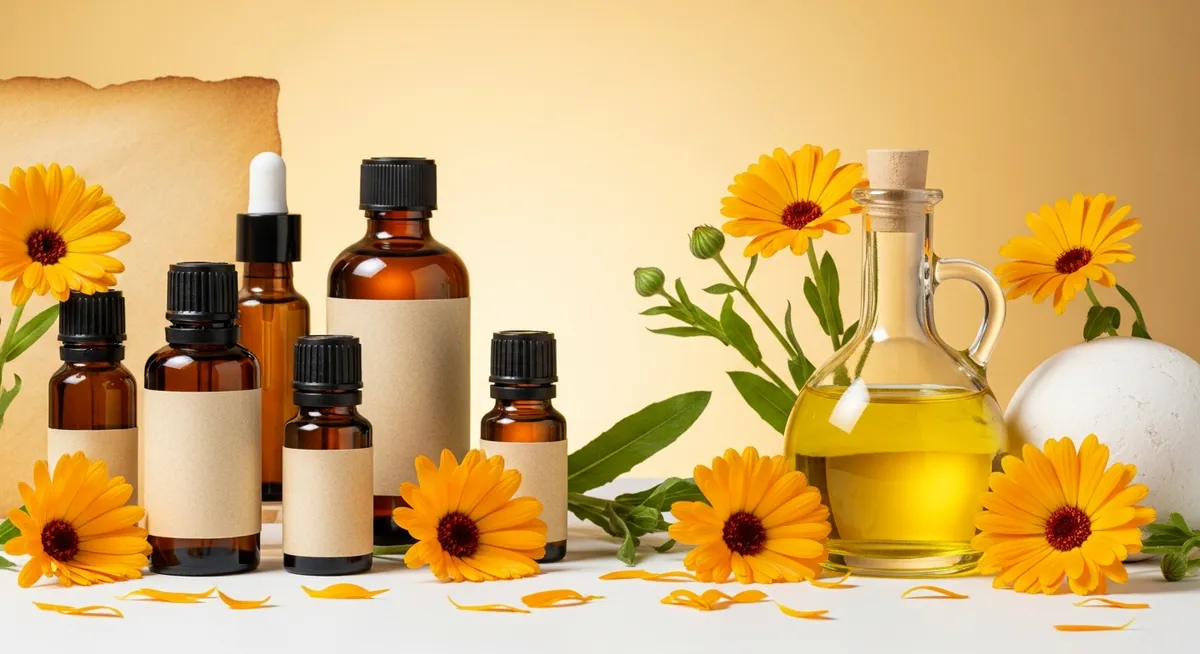
Choosing a Calendula Oil Size: Match the Bottle to the Job
The best calendula oil size is the one you will use up while the oil is still fresh, and we would decide in this order: first whether your skin tolerates calendula at all, then how fast you will realistically use it, and only then the price per ounce. We make one oil and bottle it in ten sizes, from 0.5 oz to 400 lb, so the choice is about quantity and purpose, not about a "good" version and a "budget" version.

Calendula Oil
Our own small-batch calendula oil, in sizes from 0.5 oz to bulk.
From $13.99
Shop Calendula Oil →Why price per ounce is the wrong first filter
Cost per ounce falls as bottles get bigger, which is true of nearly every liquid product, so it will always point you at the biggest container. That is a poor guide here for two reasons. First, if you have never put calendula on your skin, the cheapest-per-ounce bottle is the one you may end up not using. Second, oils slowly oxidize once exposed to air, and a bottle you open for a year is a different proposition from one you finish in a few months. We do not list prices in this article because they change; the shop page shows current sizes and prices, and the free-shipping threshold, which can shift which size makes sense.
If you have never used it: buy the smallest bottle
Calendula is in the Asteraceae (daisy) family, and the EU herbal monograph lists hypersensitivity to Asteraceae plants as a contraindication and notes that skin sensitization has been reported, frequency unknown (EMA/HMPC, 2018). In one Austrian clinic series of 443 patients referred for dermatitis, 9 (about 2%) reacted to a marigold patch-test preparation (Reider et al., Contact Dermatitis, 2001). Those were clinic patients, so the figure is not a rate for the general public, but it is a good reason to find out cheaply before committing.
The 0.5 oz bottle exists for this. A dermatologist's version of a home trial is the repeated open application test: in a survey of 67 American Contact Dermatitis Society members, most applied leave-on products twice daily, most often to the forearm, for one week (49%) or two weeks (32%), and the authors state that no standardized method has been established (Brown et al., Dermatitis, 2015). The original protocol applied the substance twice daily for 7 days to the inner forearm, stopping if dermatitis appeared sooner (Hannuksela and Salo, 1986). In the sources we reviewed we did not find a dermatology society endorsing a quick one-day dab as a home test, so we would not describe one as proof of safety. Our patch test walkthrough covers the steps, and a reaction means stop and see a dermatologist.
Sizes from 1 oz to 8 oz: match the bottle to your pace
Once you know your skin is fine with it, the only question is speed of use. The chemistry of why that matters is not specific to calendula: a 2025 review lists light, heat, oxygen and trace metals as the things that start and speed oil oxidation, and notes that oils with more double bonds (linoleic acid, for example) oxidize far faster than oleic-rich or saturated ones (Gharby et al., Food Chemistry X, 2025). Another review recommends dark glass, cool, dry storage away from heat sources (Dash et al., Frontiers in Nutrition, 2026).
Reasoning from that, the practical consequence is that every time you open a bottle you let in air, so a bottle you open daily for a long time ages differently from one you open a few times. We do not publish shelf-life test data for our oil and will not invent a number: our bottles are dated and lot-numbered, in glass in every size, and the date is there so you can judge. For supplier context, one commercial calendula macerate data sheet quotes 36 months for a sealed container stored at 15-25 C away from air and light (Golgemma/Biolandes, FB026, 2025); that figure belongs to that product, not ours, and it applies to unopened product. Our storage article covers keeping an open bottle.
A simple rule follows: pick the size you expect to finish well within a season, and note the date you opened it on the label.
If you formulate or make products: size by stage
For makers, our bulk guide suggests a 4 oz or 8 oz bottle for stability and compatibility testing, and 16 oz for a first small production run, before moving to the 5 lb and larger sizes. Bulk sizes are on the same shop page with no separate wholesale gate. The reason to test small first is that a recipe is a system: calendula oil that behaves in one base may not in another, and a failed 400 lb decision costs far more than a failed 8 oz test. See our bulk buying guide and the crafter's buying guide.
Two things the size will not do for you. First, nothing is added to our oil: no synthetic preservatives, no added tocopherol, no stabilizers. For an oil-only product that is simple. If you add water, the preservation system is yours to design and verify. A 2018 review states that water-containing cosmetics require preservation against microbial contamination, verified for example by challenge testing (Halla et al., Molecules, 2018), and an older SCC review makes the same point more bluntly: the only limit to microbial life is the availability of liquid water (Brannan, J Soc Cosmet Chem, 1995). Second, making cosmetics for sale carries obligations that are yours, not your supplier's. FDA says home manufacture is legal, requires no pre-approval, and puts safety substantiation and labeling on the firm whose name is on the label (FDA, small business fact sheet, 2025).
What stays the same at every size: the paperwork
Every batch of ours is tested by independent third-party labs (physical assays, chemical assays and contaminant screening), and batch documentation is available on request: email the lot number to [email protected]. A Certificate of Analysis PDF is linked on the shop page. Ask the same of any supplier at any size, and ask what was actually tested, because a certificate lists only the tests that were run. A 2023 review of botanical ingredient fraud notes that a single UV-based assay is sometimes the only composition data on a certificate and cannot distinguish genuine material from a lookalike (Gafner et al., J Nat Prod, 2023). We do not claim our paperwork shows more than it shows; read it for what it lists.
Who should not buy any size
Skip it if you are allergic to daisy-family plants. The EU monograph does not recommend skin use under age 6 and says safety in pregnancy and breastfeeding has not been established, which is absence of data, not proof of harm; ask a pediatrician, OB/GYN or midwife before using it on a baby or while pregnant. A rash, a wound that is not minor, or a skin condition is a dermatologist's question, not a bottle-size question. If a season goes badly and flowers do not meet our standard, we sell out rather than lower the bar, so a size can be out of stock; that is deliberate.
If you are still unsure, start with the smallest bottle, test it as described, and move up only once you know you will use it. The shop page lists every size.
Calendula Oil
Nature's Golden Botanical, bottled: small-batch calendula oil in sizes from 0.5 oz to bulk.
From $13.99
Shop Calendula Oil →Sources & Further Reading
- EMA/HMPC, 2018. European Union herbal monograph on Calendula officinalis L., flos (Revision 1), EMA/HMPC/437450/2017. ema.europa.eu
- Reider N et al., 2001. The seamy side of natural medicines: contact sensitization to arnica and marigold. Contact Dermatitis 45(5):269-72. PMID 11722485
- Brown GE et al., 2015. Clinical utilization of repeated open application test among American Contact Dermatitis Society members. Dermatitis 26(5):224-9. PMID 26367205
- Hannuksela M, Salo H, 1986. The repeated open application test (ROAT). Contact Dermatitis 14(4):221-7. PMID 2941220
- Gharby S et al., 2025. Vegetable oil oxidation: mechanisms, impacts on quality, and approaches to enhance shelf life. Food Chemistry X 28:102541. doi:10.1016/j.fochx.2025.102541
- Dash B et al., 2026. Cold pressed oils: a systematic review on physicochemical properties, nutritional composition and pharmacological activities. Frontiers in Nutrition 13:1747029. doi:10.3389/fnut.2026.1747029
- Golgemma/Biolandes, 2025. Technical data sheet, Calendula Org Macerate/Oil, FB026. biolandes.com
- Halla N et al., 2018. Cosmetics preservation: a review on present strategies. Molecules 23(7):1571. PMID 29958439
- Brannan DK, 1995. Cosmetic preservation. J Soc Cosmet Chem 46:199-220. library.scconline.org
- FDA, 2025. Small Businesses & Homemade Cosmetics: Fact Sheet. fda.gov
- Gafner S et al., 2023. Botanical ingredient forensics: detection of attempts to deceive commonly used analytical methods. J Nat Prod 86(2):460-472. PMC9972475