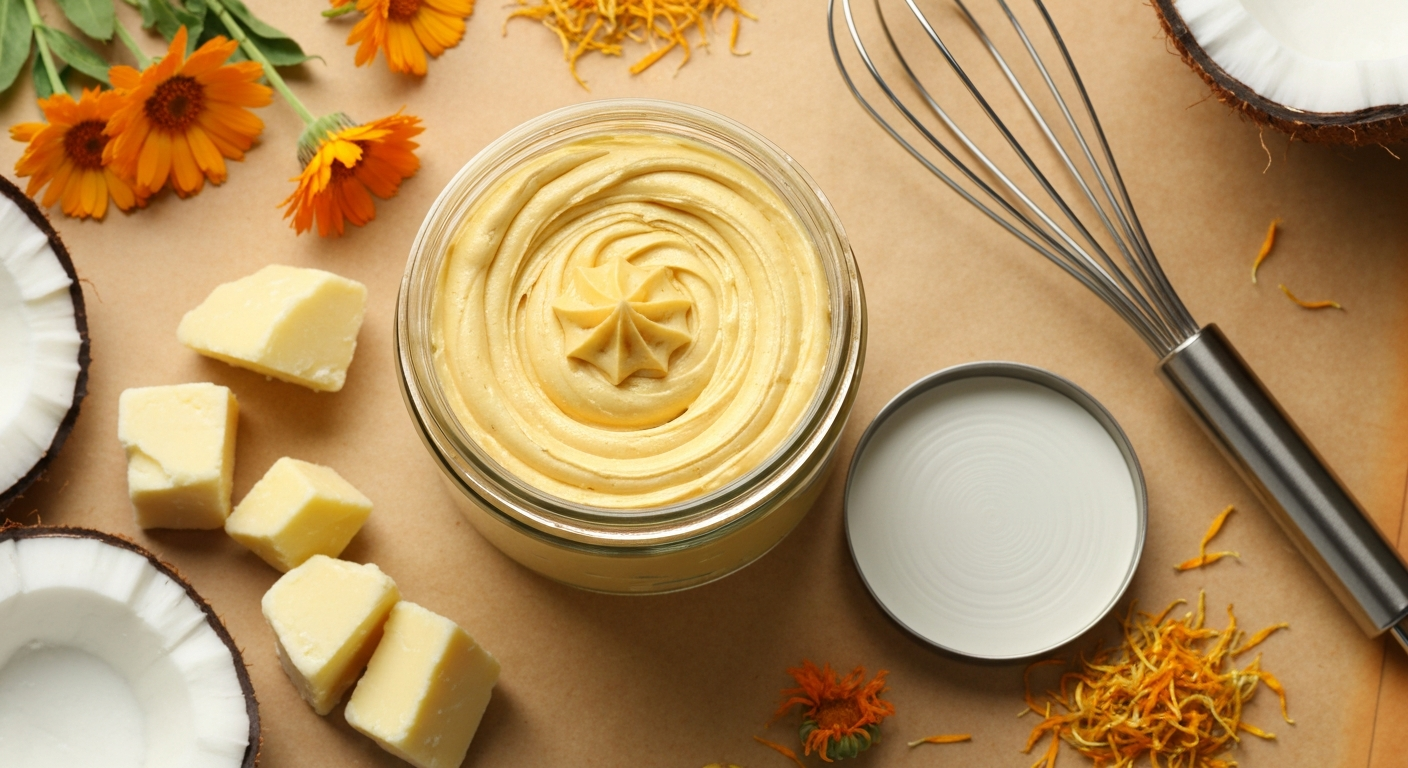
How to Make Calendula Oil Body Butter: Luxurious DIY Recipe
If you make a body butter with calendula oil, the first thing to work out is how much calendula is actually in the jar, because the answer is smaller than the name suggests. A butter that is 40% calendula oil by weight is 40% oil, and the oil is itself mostly carrier. Here is a workable formula, the arithmetic, and the decisions that depend on what you want the butter to be.

Calendula Oil
Our own small-batch calendula oil, in sizes from 0.5 oz to bulk.
From $13.99
Shop Calendula Oil →A formula with a source, and what it does not tell you
The one starting ratio we could verify is 3 parts butter to 2 parts oil by weight: the Lab Muffin blog says "the most basic whipped body butter recipe uses 3:2 butter/oil", with a batch of 100 g shea butter to 67 mL grapeseed oil, and no water, which it calls "technically not a lotion" (Lab Muffin, DIY whipped body butter). In weights:
- 100 g shea butter
- 67 g calendula oil
Weigh the oil instead of measuring it by volume: the Lab Muffin author notes 1 mL equals 1 g for that oil, and a calendula macerate data sheet lists a specific gravity of 0.91-0.93, so 67 g of such an oil is about 72-74 mL (Golgemma/Biolandes, FB026, 2025). The two weights make a 167 g batch, with calendula oil making up about 40% of it. The cooling technique, graininess fixes and keeping-time limits are in the whipped body butter article; this one is about the formula decisions. We could not fetch a second source we could verify for butter ratios, and the ones in search results contradicted each other, so treat 3:2 as a place to start.
The dose arithmetic
Home infusions are usually described as flower weight to oil weight. The EU herbal monograph defines the oil preparation as 1:10 in a fatty vegetable oil (EMA/HMPC, 2018), and a 2005 lab study found the richest carotene content at 1:5 by weight (Novkovic et al., Hemijska industrija, 2005). Reasoning from those, and counting each ratio as grams of flower per gram of oil:
| Oil made at | Flower per 100 g oil | Flower-equivalent in the butter (40% oil) |
|---|---|---|
| 1:10 | about 10 g | roughly 4% |
| 1:5 | about 20 g | roughly 8% |
For comparison, the same EU monograph describes semi-solid skin products as containing the equivalent of 2-10% herbal substance, with 2-8% for the oil-extract type. So a butter with 40% of a 1:10 oil lands inside that band. Two cautions. This is a regulatory range for licensed traditional-use herbal medicines, not a cosmetic target and not a dose recommendation. And the EU says its clinical evidence is inconclusive: the traditional use is "exclusively based upon long-standing use", for minor skin irritation and minor wounds. We make no claim about what the butter will do for your skin; the arithmetic is only to show what is in the jar. We do not state the herb-to-oil ratio of our own oil here, so the table works only for oil whose ratio you know.
Decide what you are making
A butter is one of three products people confuse, and the right one depends on the job.
- Whipped butter, no water. Soft, spreadable, and with far lower microbial risk than a lotion, because water is what makes cosmetics need preservation (Brannan, J Soc Cosmet Chem, 1995). It can still go rancid or pick up microbes from fingers; FDA says to wash hands before dipping into a container (FDA, Microbiological Safety and Cosmetics).
- Salve or balm. Firmer, easier to carry, and the one with a published ratio from a supplier: Mountain Rose Herbs suggests about 1 oz beeswax to 4 oz infused oil, with less beeswax for softer and more for firmer (Mountain Rose Herbs), plus its own claim of 1 to 3 years in a cool place. Its units mix weight and volume, so use it as a ratio of feel, not a measured spec. See the salve recipe.
- Lotion or cream. Water-based, and it needs a preservative system verified by challenge testing (Halla et al., Molecules, 2018). We have no verified home recipe and do not suggest making one.
Our judgment from the evidence: for a first batch, a water-free butter or salve is the safer category, and the butter is the better choice only if you want a spreadable texture. See also calendula oil vs shea butter for how the two ingredients differ.
Keeping time: what the components say
A refined shea data sheet states 24 months and a melting point range of 28-40 C (DistrEbution GmbH, 2025), a manufacturer claim for a sealed product. University of Maine says to use homemade infused oils within three months; Soap Queen says 6 months to a year by carrier (University of Maine; Soap Queen). Those sources disagree and cover different things, and no source gives a shelf life for the finished butter. Take the short end, date the jar, and discard anything that changes in smell or shows mould.
If you plan to sell it
FDA says it is not against the law to make cosmetics at home, but you must avoid adulteration (including microbial contamination), ensure safety is substantiated and records kept, and label correctly; a P.O. box or website is not enough for the name and place of business on the label. It also says FDA does not define "natural" or "organic" for cosmetics (FDA, Small Businesses and Homemade Cosmetics fact sheet). Whether MoCRA registration applies turns on your sales and products, and we are not giving legal advice: see the FDA guidance or a lawyer. Do not write that the butter treats, repairs or prevents anything; that moves it from a cosmetic toward a drug claim.
We make one oil, and we do not sell a butter. If you formulate with ours, the batch documentation (email the lot number to [email protected]) helps with your own records, and our bulk guide suggests testing with a 4 oz or 8 oz bottle for compatibility before buying more (buying calendula oil in bulk).
Who should not use it
The EU monograph lists hypersensitivity to Asteraceae (daisy family) as a contraindication, notes skin sensitization has been reported, says skin use under age 6 is not recommended and says safety in pregnancy and breastfeeding is not established (EMA/HMPC, 2018). Patch test first, and ask a dermatologist, pediatrician or OB/GYN or midwife as appropriate.
If you would rather start from a documented oil than make one, our calendula oil is infused from dried flowers with no preservatives or stabilizers added. Whichever oil you use, weigh it and write the numbers down; that is what makes a second batch repeatable.
Calendula Oil
Nature's Golden Botanical, bottled: small-batch calendula oil in sizes from 0.5 oz to bulk.
From $13.99
Shop Calendula Oil →Sources & Further Reading
- Lab Muffin. DIY whipped body butter. labmuffin.com
- EMA/HMPC, 2018. European Union herbal monograph on Calendula officinalis L., flos. ema.europa.eu
- Novkovic et al., 2005. Determination of total lipids and characterization of marigold flower extracts. Hemijska industrija. doi.org/10.2298/HEMIND0510254N
- Golgemma/Biolandes, 2025. Technical data sheet FB026, Calendula Org Macerate/Oil. biolandes.com
- Brannan DK, 1995. Cosmetic preservation. J Soc Cosmet Chem 46:199-220. library.scconline.org
- Halla N et al., 2018. Cosmetics preservation: a review on present strategies. Molecules. PMID 29958439
- FDA. Microbiological Safety and Cosmetics. fda.gov
- FDA, 2025. Small Businesses and Homemade Cosmetics: Fact Sheet. fda.gov
- Mountain Rose Herbs. How to Make Herbal Salves. blog.mountainroseherbs.com
- DistrEbution GmbH, 2025. Technical data sheet, Shea butter refined (D10126). distrebution.com
- University of Maine Cooperative Extension. Safe Homemade Flavored and Infused Oils (Bulletin 4385). extension.umaine.edu/publications/4385e
- Soap Queen (Bramble Berry). Infusing Oil. soapqueen.com