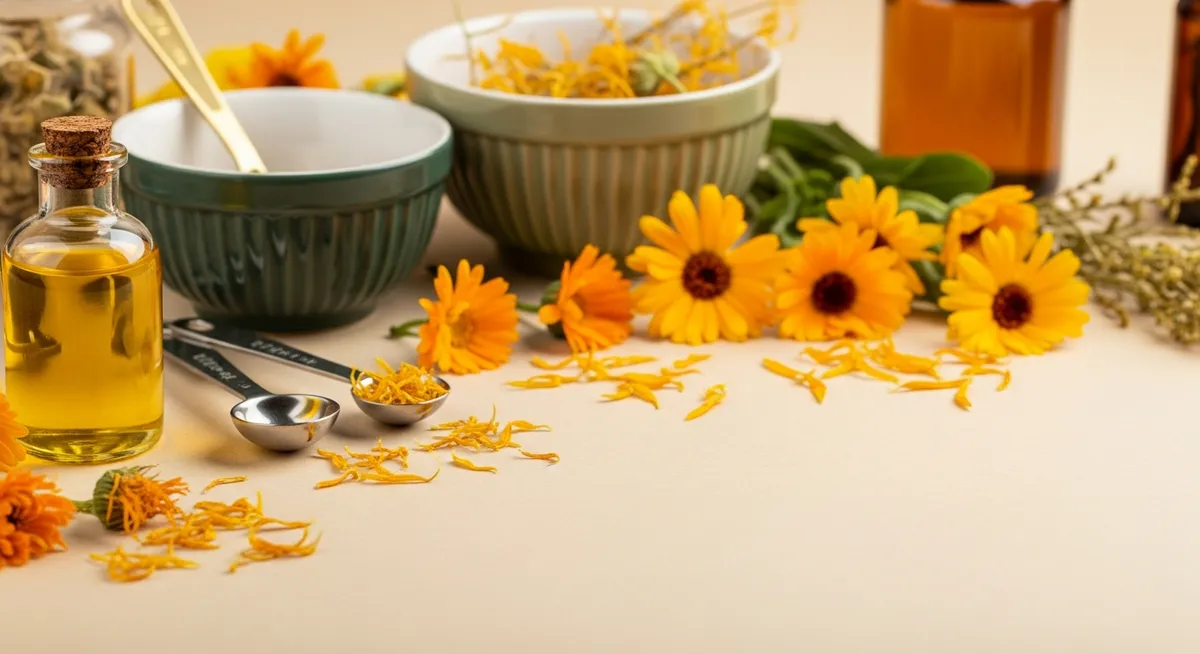
Calendula Oil as a Perfume Base: What It Adds and Lacks
Calendula oil is a poor choice if what you want is a scent. It makes a good base for a perfume oil, because it is an oil you can dilute scented materials into, but the fragrance in a "calendula perfume" comes from whatever else you add. We make one product, an infused calendula oil, and this page is about using it as a base and where that goes wrong.

Calendula Oil
Our own small-batch calendula oil, in sizes from 0.5 oz to bulk.
From $13.99
Shop Calendula Oil →Start at the bench: a 10 mL roller bottle
Picture the project. You have an empty roller bottle, our calendula oil, and some essential oils. You want a skin-worn scent. Three questions decide whether it ends well, and they come in this order: what are you adding, how much, and what are you wearing it on?
Question 1: where does calendula's own scent come from, and is it enough?
Not much of it is available as scent. Distilling calendula flowers gives only a little volatile oil: the EU assessment report puts it at 0.2-0.3% of the herb, mostly sesquiterpenes (EMA/HMPC, 2008), and a 2015 lab study got 0.9 g per 100 g of dry flowers by hydrodistillation, with alpha-cadinene and delta-cadinene the main compounds (Salome-Abarca et al., Botanical Sciences, 2015). That distilled oil is a different material from the orange infused oil. An infused oil is petals soaked in a carrier, and most of what is in the bottle by weight is the carrier.
What does an infused calendula oil smell like? We do not have a sourced scent profile for our own oil and we will not invent one. For comparison only, one commercial organic macerate data sheet describes its odor as "floral, slightly bitter" (Golgemma/Biolandes FB026, 2025). Smell a sample before you design a blend around it, because the odor of an infused oil depends on the flowers, the carrier and the oil's age.
Question 2: how much scent is safe to put on skin?
This is where an oil-based perfume differs from a spray. There is no alcohol and no water, so every drop of essential oil sits against your skin at the concentration you mix. The Tisserand Institute's dilution ranges put facial cosmetics at 0.5-1.2%, body oils and lotions at 1-3%, and "pain and rollerballs" at 3-10%, with 0.2-1% for sensitive or impaired skin (Tisserand Institute, Dilution for essential oils). Its age chart for adults shows 2.5-5% for ages 15 and up and 1-2% for ages 2-6 (Tisserand Institute, recommended dilutions by age). NAHA, a trade association, says most aromatherapy blends fall between 1% and 5% (NAHA, Safety).
These do not agree, and they were not written for perfume. Our position is to take the low end: this is a product you will wear daily, near your face and neck. Arithmetic, not a recipe: a 10 mL roller bottle at 1% holds 0.1 mL of essential oil in total. Start there and increase only if you have to, as the Institute advises.
- Allergy, not irritation, is the usual failure. The Institute states allergic reactions are the most common reaction to essential oils, and that they can persist for days or weeks (Tisserand Institute, Irritation and allergic reactions). A daily-wear scent gives repeated exposure.
- Citrus top notes can be phototoxic. The Institute says expressed citrus rind oils can be phototoxic because of furanocoumarins, while distilled citrus oils are not (Tisserand Institute, Citruses). A perfume goes on exposed skin. Choose distilled, or leave citrus out. Our own signature blend uses sweet orange, which that page describes as generally thought not to be phototoxic even when expressed, but check the label of whatever you buy.
- "Natural" is not a safety category. FDA says components of fragrance formulas may cause allergic reactions, and that the law treats ingredients from plants the same as those from any other source (FDA, Fragrances in Cosmetics). Our essential oil pairing guide goes through specific oils.
Question 3: the oil base itself
An oil perfume has two enemies: oxidation and staining.
- Oxidation. Light, heat and oxygen speed oil oxidation (Gharby et al., Food Chemistry X, 2025), and a perfume sits in a handbag, which has all three. A commercial macerate sheet lists 0.2% added tocopherol; ours has none added, no preservative and no stabilizer. Use a dark roller bottle, make a small batch, and note that the lot number and date on our bottle tell you how old the base is.
- Staining. Calendula oil is orange from carotenoids. Reasoning from that, it can mark light fabric at the neckline; we have not tested how much, so test on a white cotton cloth first.
- No water. Keep the blend water-free. A 1995 review states the cosmetics that most need preservatives are those that contain water (Brannan, J Soc Cosmet Chem, 1995).
Product-type vocabulary, so you buy the right thing
"Calendula absolute" and "calendula CO2" are not infused oil. Tisserand explains that absolutes and concretes are solvent extracts and that CO2 extracts are neither essential oils nor absolutes (Tisserand, essential oils, absolutes, concretes and CO2 extracts). If a recipe calls for one, do not substitute our oil one for one; the materials are not interchangeable and we have no data on a swap.
Who should not make or wear this
- Anyone allergic to the daisy (Asteraceae) family. The EU herbal monograph lists hypersensitivity to Asteraceae as a contraindication and says skin sensitization has been reported (EMA/HMPC, 2018). Patch test the finished blend on the inner forearm, not just the oil alone, because the scent materials are separate allergens. See our allergy FAQ.
- Households with cats. Pet Poison Helpline advises concentrated essential oils should never be applied directly to cats, and notes oils can be swallowed during grooming (Pet Poison Helpline, Essential oils and cats). That page is about essential oils, not calendula oil, but a scented blend contains them. Ask your veterinarian.
- Babies and young children. The Institute's chart for ages 0-3 months is 0.1-0.2%; a scented adult perfume is not that, and we would not make one for a baby.
We can speak to the flower, the infusion and the batch paperwork, not to fragrance design. For other projects with calendula oil, see 12 DIY recipes and the crafter's buying guide.
Calendula Oil
Nature's Golden Botanical, bottled: small-batch calendula oil in sizes from 0.5 oz to bulk.
From $13.99
Shop Calendula Oil →Sources & Further Reading
- EMA/HMPC, 2008. Assessment report on Calendula officinalis L., flos (superseded; EMEA/HMPC/179282/2007). ema.europa.eu/179282/2007
- Salome-Abarca LF et al., 2015. Chemical composition of scented extracts obtained from Calendula officinalis by three extraction methods. Botanical Sciences 93(3):633-638. scielo.org.mx/bs/v93n3a16
- Golgemma/Biolandes, 2025. Technical data sheet, Calendula Org Macerate FB026. biolandes.com/FB026
- Tisserand Institute. Dilution for essential oils. tisserandinstitute.org/dilution
- Tisserand Institute. Recommended dilutions for different age groups. tisserandinstitute.org/children
- NAHA. Safety. naha.org/safety
- Tisserand Institute. Irritation and allergic reactions. tisserandinstitute.org/safety
- Tisserand Institute. Citruses: a comparison of different oils. tisserandinstitute.org/citruses
- U.S. FDA. Fragrances in Cosmetics. fda.gov/fragrances-cosmetics
- Gharby S et al., 2025. Vegetable oil oxidation. Food Chemistry X 28:102541. PMC12146556
- Brannan DK, 1995. Cosmetic preservation. J Soc Cosmet Chem 46:199-220. library.scconline.org
- Tisserand R. Essential oils, absolutes, concretes and CO2 extracts. roberttisserand.com/?p=4514
- EMA/HMPC, 2018. EU herbal monograph on Calendula officinalis L., flos. ema.europa.eu/EMA/HMPC/437450/2017
- Benson K. Essential oils and cats. Pet Poison Helpline. petpoisonhelpline.com