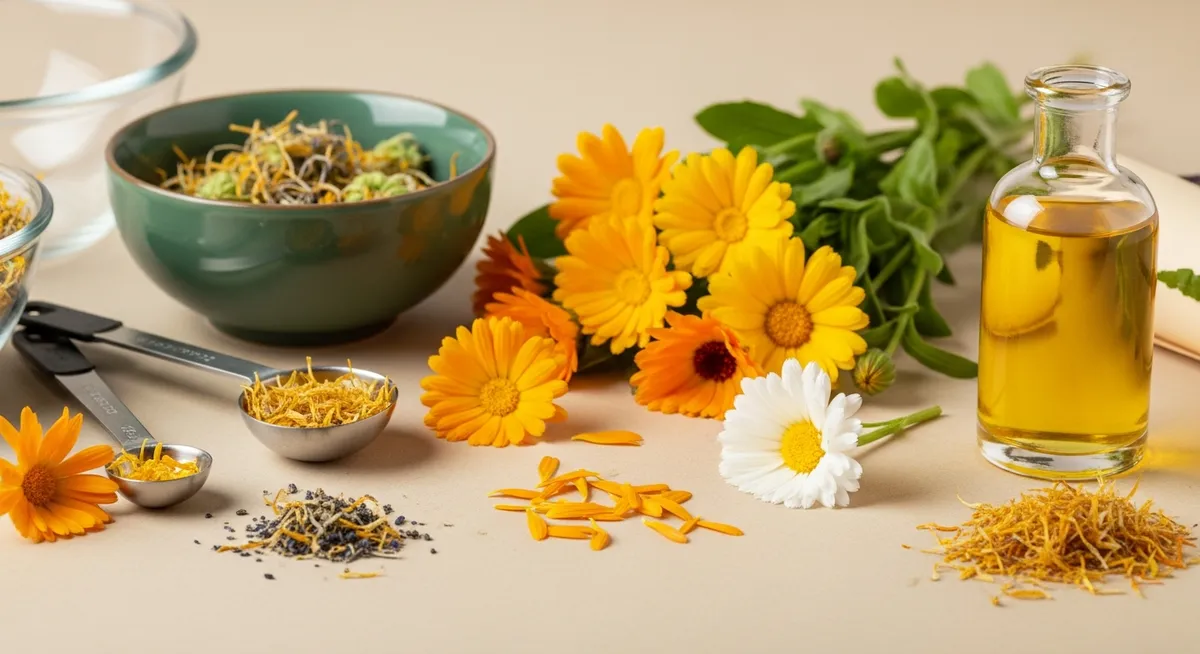
Making Hand Balm With Calendula Oil: What a Home Cream Needs
Before you make anything with calendula oil for dry, cracked hands, sort out two things: whether your problem is dry skin at all, and whether you want a cream or a balm. A "cream" has water in it, and a home-made one with water and no tested preservative is the part of this project we would advise against. A water-free balm made with our calendula oil is the version we would help you make.

Calendula Oil
Our own small-batch calendula oil, in sizes from 0.5 oz to bulk.
From $13.99
Shop Calendula Oil →Step 1: dry hands or hand eczema?
The American Academy of Dermatology says hand eczema "can easily be mistaken for dry skin," and that "you need more than a good moisturizer to get rid of hand eczema." Its signs include dry, chapped skin (often the first sign), deep painful cracks, and bleeding or weeping skin, plus itching, burning, blisters, crusts or pus. It adds that without treatment and prevention hand eczema tends to worsen, and that treatment starts with finding and avoiding the trigger, which can be as ordinary as frequent wet hands or as specific as a chemical, solvent or latex glove (AAD, hand eczema).
So the decision rule is simple. If your hands are very dry and painful and moisturizing through the day fails to bring relief, see a dermatologist before you start a craft project. The same applies to bleeding, weeping, blistering or pus. A balm is not a substitute for finding the cause.
Step 2: what the dermatology advice says a hand product should be
The AAD's hand-care tips describe a fragrance-free, dye-free hand cream or ointment containing lipids such as ceramides, humectants such as glycerin or hyaluronic acid, and occlusives such as petrolatum. They favor tubes over pump lotions, advise moisturizing after every handwashing and sanitizer use and at night, and say to keep washing your hands even when they are dry, since "using moisturizer after handwashing does not negate your handwashing efforts" (AAD, 4 skin care tips for your hands).
Read that against a home recipe. Calendula oil is an oil: it is a lipid, and with a wax it becomes an occlusive-style layer. It is not a humectant. Two details in the AAD advice matter for a DIY balm: fragrance-free, and an ointment-type texture. We would leave out essential oils entirely for hands that are already cracked; the FDA notes that components of fragrance formulas may cause allergic reactions in some people (FDA, Fragrances in Cosmetics), and broken skin is where you least want to find out.
Step 3: cream or balm, which is really a water question
A cream is an oil-and-water emulsion. A balm or salve is oil and wax. The distinction is about safety more than texture:
- A 1995 review of cosmetic preservation states that the cosmetics that most need preservatives are those containing water, while low-water-activity products need far less (Brannan, J Soc Cosmet Chem, 1995).
- FDA lists contaminated water and an ineffective preservation system among the ways cosmetics become harmful, and notes the injuries are not common but can be serious (FDA, Microbiological Safety and Cosmetics). Its 2016 inspection manual flags products labeled "natural" or "no preservatives" for microbial sampling when preservation is in doubt (FDA CPGM 7329.001, 2016).
Our position, then: if you make a hand cream with water in it, you need a preservative system you have reason to trust, and we cannot supply a sourced home-use one. We found no fetched source on emulsifiers or preservatives for home makers, so we are not going to improvise a recipe. Our oil itself has no preservative, no added tocopherol and no stabilizer, which is fine for an oil but is not a preservative system for a water-containing product. A balm sidesteps the problem.
Step 4: how we would make a balm
This is a starting point from a published herbal-retailer recipe, not a tested formula. Mountain Rose Herbs' salve recipe uses 1 ounce of beeswax to 4 ounces of infused oil, softer with less wax and firmer with more, melted in a double boiler on low heat and poured into tins (Mountain Rose Herbs, How to Make Herbal Salves). Their units mix weight (wax) and volume (oil), so treat the 1:4 as approximate. We would adjust the firmness for hands, where you want it to spread without tackiness, by making a small test tin first.
- Use our oil as the infused component. It is a finished oil, so there is no infusing step. It comes in 1 oz to 16 oz sizes (and larger), and our bulk guide suggests a small bottle for testing a formulation before committing. Our bulk guide is at that link if you are scaling up.
- Optional shea. A refined shea butter data sheet lists a melting range of 28-40 C (DistrEbution GmbH data sheet D10126, 2025), so it softens on warm hands. Our shea comparison covers that trade-off.
- Keep every utensil and tin dry. Stray water is the one thing that turns a low-risk balm into a higher-risk product.
- Shelf life is unsettled. Mountain Rose says its salves keep 1-3 years in a cool place; Soap Queen says infused oils keep 6 months to a year depending on carrier (Soap Queen, Infusing Oil); the University of Maine tells makers not to keep homemade infused culinary oils more than three months (University of Maine Extension, Bulletin 4385). These cover different products, and none is a test of your balm. We would make a small tin and use it within a few months. That is judgment, not data.
What the calendula evidence does and does not cover
Most calendula skin trials used extracts, ointments or creams, not infused oils, so whether an oil in a balm does anything for hands is an inference. In a 2025 double-blind study of 20 healthy volunteers with induced skin irritation, forearm hydration was higher at sites with an emollient cream containing 1% CO2 calendula extract than at placebo-cream or untreated sites on day 4 (Crnčević et al., Acta Pharm, 2025). That is the closest we found, and it is neither chronic dry hands nor an oil. We found no human trial of calendula on chapped or cracked hands.
Who should skip it
Calendula is in the daisy (Asteraceae) family. The EU herbal monograph lists hypersensitivity to that family as a contraindication and notes skin sensitization has been reported, frequency unknown (EMA/HMPC, 2018). Patch test on the inner forearm first, and be especially cautious on cracked skin, where the barrier is already open. Our allergy FAQ explains how. If you are allergic to ragweed or chrysanthemums, skip it.
We make one oil and can answer questions about the flower, the infusion and the batch paperwork. For hands that crack and bleed, the dermatologist comes first and the balm second. For related projects, see the salve recipe and the nail and cuticle guide.
Calendula Oil
Nature's Golden Botanical, bottled: small-batch calendula oil in sizes from 0.5 oz to bulk.
From $13.99
Shop Calendula Oil →Sources & Further Reading
- American Academy of Dermatology. Hand eczema. aad.org/hand-eczema
- American Academy of Dermatology. 4 skin care tips for your hands. aad.org
- U.S. FDA. Fragrances in Cosmetics. fda.gov/fragrances-cosmetics
- Brannan DK, 1995. Cosmetic preservation. J Soc Cosmet Chem 46:199-220. library.scconline.org
- U.S. FDA. Microbiological Safety and Cosmetics. fda.gov
- U.S. FDA, 2016. Compliance Program Guidance Manual 7329.001, Cosmetics Program, Chapter 29. fda.gov/media/78441
- Mountain Rose Herbs. How to Make Herbal Salves. blog.mountainroseherbs.com
- DistrEbution GmbH, 2025. Technical Data Sheet, Shea butter refined, D10126. distrebution.com/D10126
- Soap Queen (Bramble Berry). Infusing Oil. soapqueen.com
- University of Maine Cooperative Extension. Safe Homemade Flavored and Infused Oils, Bulletin 4385. extension.umaine.edu/4385e
- Crnčević MŠ et al., 2025. RCT of an emollient cream with and without 1% supercritical CO2 calendula extract in contact dermatitis. Acta Pharm 75(4). pubmed/41527980
- EMA/HMPC, 2018. EU herbal monograph on Calendula officinalis L., flos. ema.europa.eu/EMA/HMPC/437450/2017